
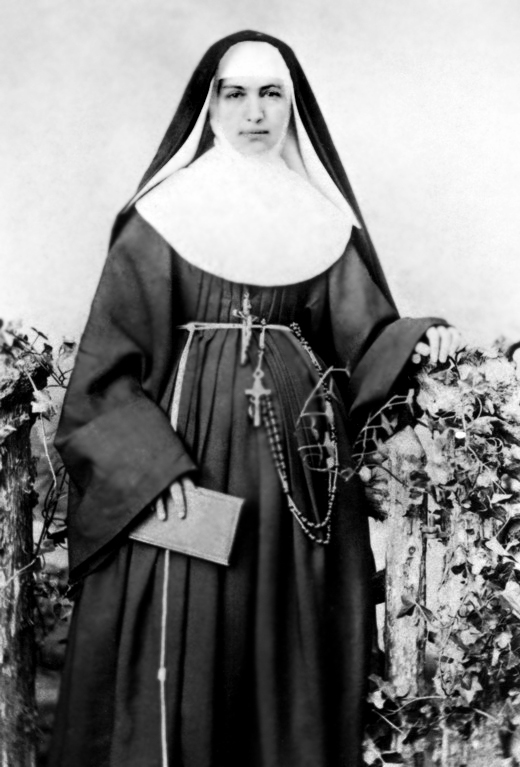
Barbara Koob (later Cope) was born in the German Rhineland and emigrated with her family to Utica, New York, in 1839. As eldest of nine she worked in factories from age fifteen to support the family until her father's death. At twenty-four she entered the Sisters of St. Francis of Syracuse, taking the name Marianne. By thirty-two she was a superior; by forty-five she was Provincial Mother of the entire Syracuse community and had co-founded two of central New York's first general hospitals — St. Elizabeth's in Utica (1866) and St. Joseph's in Syracuse (1869).
In 1883 King Kalākaua of Hawaii sent letters to over fifty religious orders begging for sisters to staff hospitals and care for the leprosy patients of his kingdom. Marianne was the only superior who answered yes. She crossed by train to San Francisco and by steamer to Honolulu with six volunteer sisters, planning to stay a year or two and return. She never left Hawaii.
For the first six years she ran the Kaka'ako receiving hospital on Oahu. In 1888 — Damien was already dying of leprosy at Kalaupapa — she crossed to Molokai with two sisters to take over the women's home Damien had founded. She nursed Damien himself in his final months, took over his work after his death, and spent the next thirty years running the Bishop Home for Women and Girls. Unlike Damien she never contracted the disease, though she lived in daily contact with hundreds of patients.
She died at Kalaupapa in 1918 at eighty, still working. She had been on Molokai for thirty years and in Hawaii for thirty-five. Her body, exhumed in 2005, was found to be entirely incorrupt despite no embalming and the salt air of a Pacific island grave for nearly ninety years.