
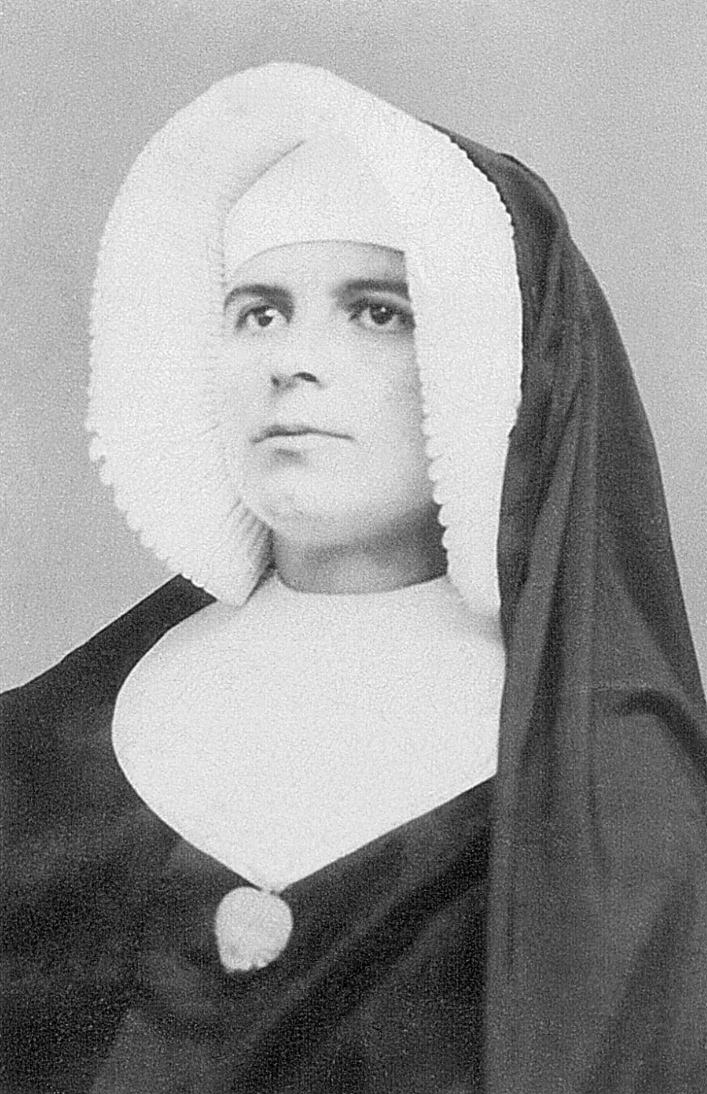
Virginie-Alodie Paradis — Élodie to her family — was born on May 12, 1840 at L'Acadie in the Richelieu valley, the only daughter among the six children of Joseph Paradis and Émilie Grégoire. At nine she boarded with the Congrégation de Notre-Dame at Laprairie. On February 21, 1854, not yet fourteen, she entered the Marianites of Holy Cross at Saint-Laurent outside Montreal, took the habit the next year, and on August 22, 1857 made her profession in the presence of the founder of Holy Cross, Bl. Basile Moreau, as Sister Marie-de-Sainte-Léonie.
She taught in Marianite convents around Montreal until 1862, then spent eight years in New York at an orphanage the sisters had taken on. Around 1870 she passed to the Indiana province when it separated from the French congregation, and in 1874 was sent to St. Joseph's College at Memramcook, New Brunswick, the Acadian college run by Fr. Camille Lefebvre, a family friend from her childhood. There her life took its turn.
At Memramcook she gathered young Acadian women who wanted religious life but had no dowry or schooling for the teaching orders, first around a sewing workshop, then as a community. Their work was the running of the college — kitchen, laundry, linen, infirmary — so that the priests could teach. On August 26, 1877 fourteen of them put on a habit. Bishop Édouard-Charles Fabre of Montreal saw that this was a genuine vocation, and in May 1880 the Holy Cross fathers recognised the Little Sisters of the Holy Family as a community with the care of their colleges.
The institute had no diocese willing to give it a canonical home for fifteen years. Bishop John Sweeney of Saint John eventually supported it; then in 1895 some of the sisters went to serve the seminary at Sherbrooke, and Bishop Paul LaRocque welcomed the mother house and novitiate there and approved the institute on January 26, 1896. Only on May 1, 1905 did Pius X release Mother Marie-Léonie from her vows to Holy Cross so that she could belong wholly to her own foundation.
She had asked her sisters for something very plain: to serve priests in their houses as Martha served at Bethany, and to see Christ in them. She wrote a short rule, the Petite Règle, and waited twenty years for leave to print it; the permission arrived on May 3, 1912, and she died the same day, aged seventy-one, in Sherbrooke. The congregation then had over forty houses and 635 sisters in Canada and the United States; it later went to Italy, Honduras, and elsewhere, and more than two thousand women have followed her.
She was buried in the Saint-Michel parish cemetery, moved to the mother house in 1935, and in 2017 laid in the cathedral of Sherbrooke, where her tomb is now a place of pilgrimage. John Paul II beatified her at Jarry Park in Montreal on September 11, 1984, the only beatification he ever celebrated on Canadian soil. Pope Francis authorised the decree on the canonisation miracle on January 24, 2024 and canonised her in St. Peter's Square on October 20, 2024. Canada keeps her feast on May 4.