
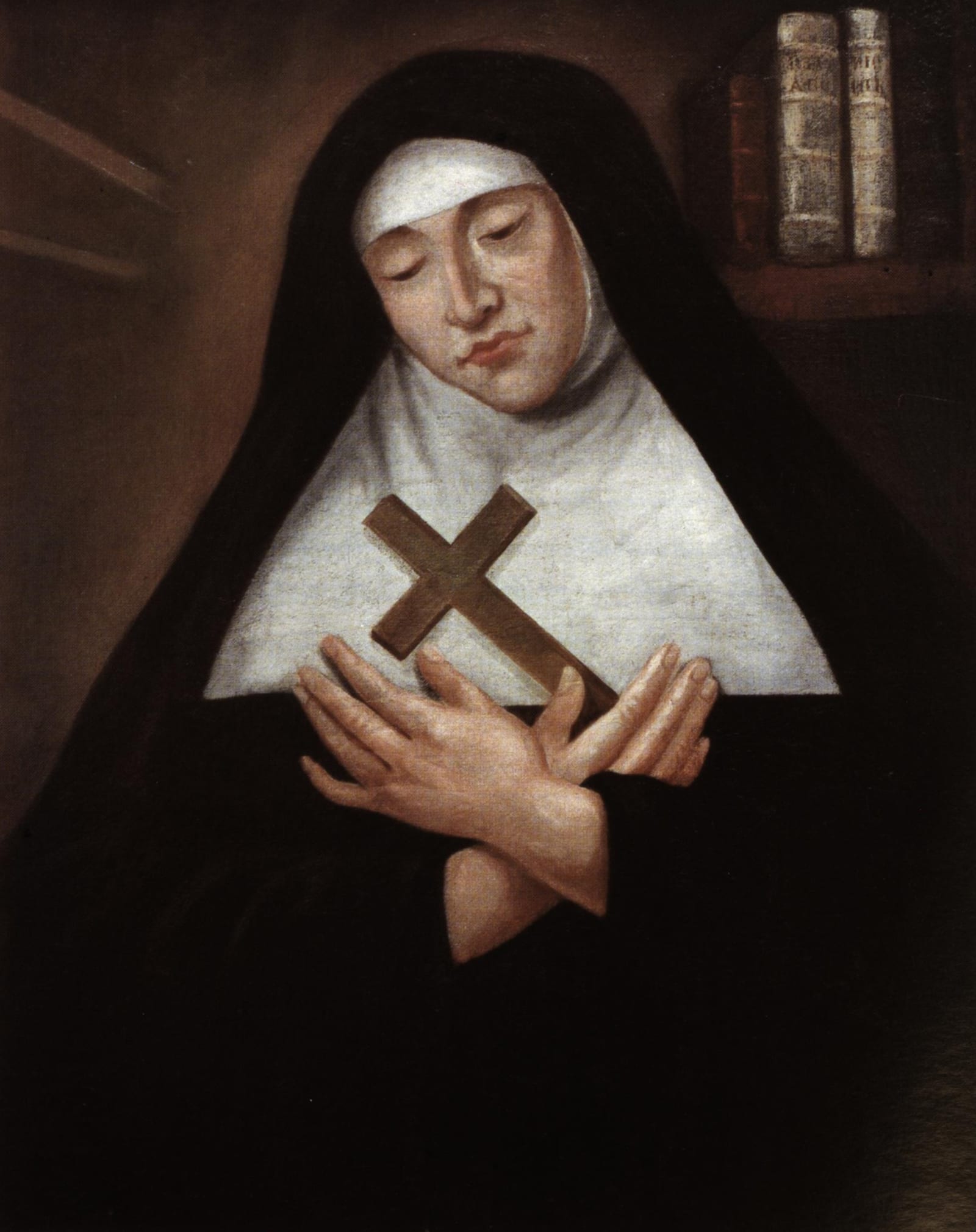
Marie Guyart was born to a baker's family at Tours, married Claude Martin in 1617 at seventeen, bore a son also named Claude in 1619, and was widowed at twenty in 1619 when her husband's business collapsed under debt. For twelve years she supported her son and her widowed brother-in-law's transport business at Tours, while pursuing an intense interior life of mystical experience that her later writings would document at extraordinary length.
In 1631, with her son now twelve and old enough to be entrusted to her sister's family, she entered the Ursulines of Tours (an enclosed teaching order — see the entry on Angela Merici for the order's foundation a century earlier in northern Italy). She made her perpetual vows in 1633. By 1638 — guided by the dream-image of a vast continent to the west that she was being commanded to evangelize — she had volunteered for the projected Canadian mission of the Ursulines.
She sailed for New France in 1639 with three companions and arrived at Quebec — then a small frontier town of about three hundred Europeans surrounded by Huron, Algonquin, and Montagnais communities — in August 1639. She founded the Ursuline monastery and school of Quebec, the first formal school for girls in North America. She mastered Algonquin, Iroquoian, and Huron languages within a decade, composed catechisms and dictionaries in all three (and an Algonquin sacred history), and trained generations of indigenous Catholic girls. Her vast spiritual writings — published mostly after her death by her son Claude (himself a Benedictine prior) — make her one of the great mystical writers of the seventeenth century. She died at Quebec on April 30, 1672. Bossuet called her 'the Teresa of New France.' She was equipollently canonized by Pope Francis in 2014 — alongside François de Laval, the first Bishop of Quebec, with whom she had co-founded the Canadian Catholic Church.