
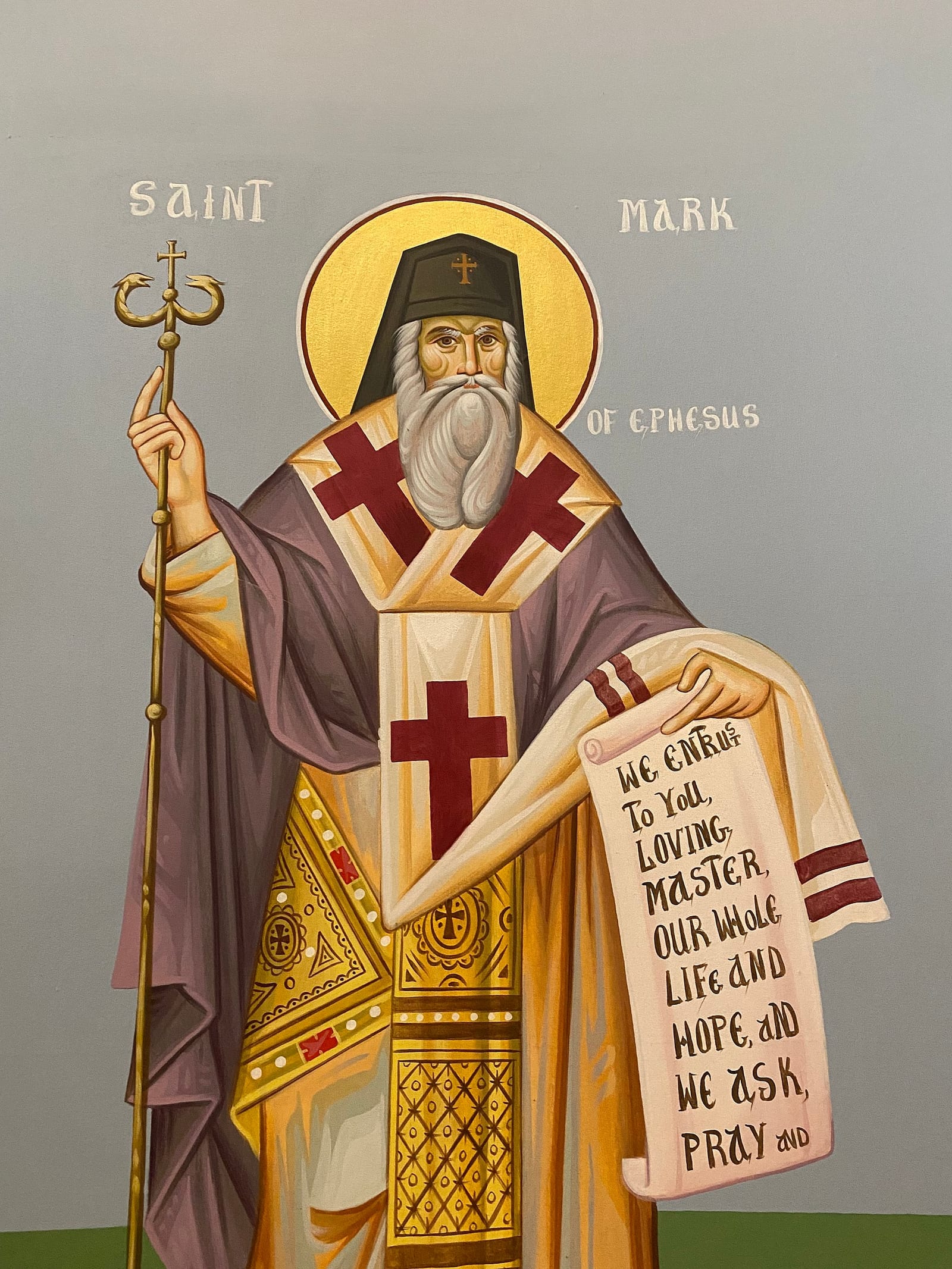
Manuel Eugenikos — Mark in religion — was born in Constantinople to an Orthodox clerical family, educated under the philosopher George Gemistos Plethon, became a monk in 1418, and was raised to the metropolitan see of Ephesus in 1437 by the dying Emperor John VIII Palaeologus, specifically for the purpose of representing Orthodox theology at the upcoming Council of Florence.
The Council of Ferrara-Florence (1438–39) was the last serious attempt at theological reconciliation between the Latin and Greek Churches. Mark led the Greek delegation in technical debate against the Latin theologians — Cardinal Cesarini, Cardinal Albergati, John of Montenero, and the Greek-born convert Bessarion. The debate centered on the Filioque (whether the Holy Spirit proceeds from the Father alone or from the Father and the Son), purgatory, papal primacy, and the use of unleavened bread in the Eucharist.
On July 6, 1439, under enormous political pressure to obtain Latin military aid against the Turks, the Greek emperor and most of the Greek delegation signed the Union of Florence. Mark of Ephesus alone among the Greek bishops refused, in spite of every form of pressure. Pope Eugene IV, on hearing of his refusal, reportedly said, 'Then we have done nothing.' Mark returned to Constantinople in 1440 and led the Greek opposition to the Union for the remaining four years of his life. His thesis — that doctrine cannot be compromised under political pressure — prevailed: the Union was repudiated in Constantinople in 1450 and never came into force in the East. He died in 1444 and was canonized almost immediately. His feast on January 19 in the Byzantine calendar remains a sensitive ecumenical issue.