
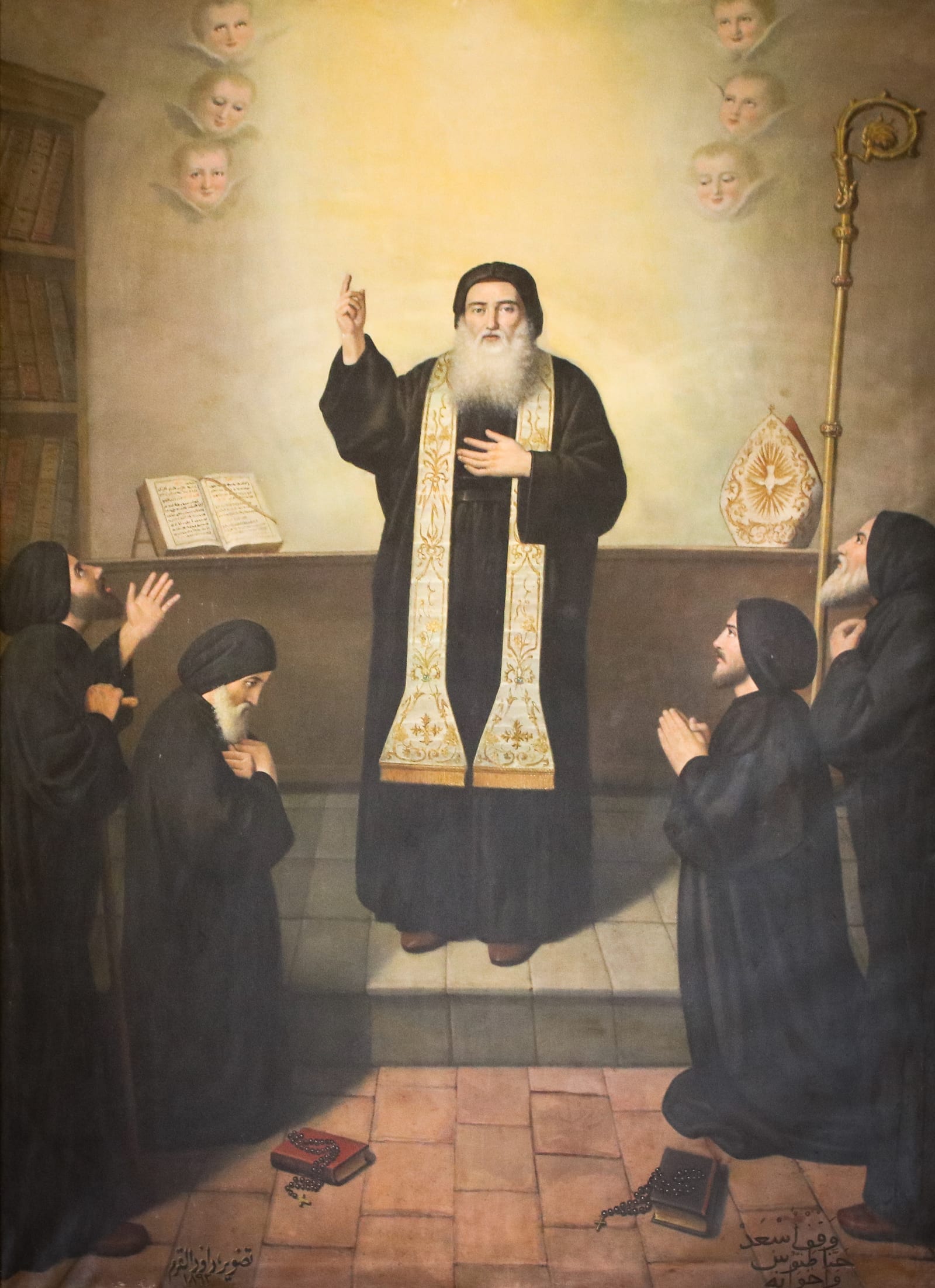
Maron (Syriac Mar Marūn, 'Lord Maron'; Greek Marōn) was a Syrian-Aramaic-speaking Christian hermit-priest of the late 4th and early 5th centuries who lived as a solitary in the wild Apamene-Cyrrhestic Syrian highlands northwest of Antioch (in what is now southeastern Turkey near the Syrian border). He is one of the small group of Syriac-tradition early-medieval Christian saints — the foundational figure of an entire Catholic ecclesial tradition (the Maronite Church) bears his name.
Theodoret of Cyrus — the great early-5th-century Syriac-bishop and historian who personally knew Maron during the last years of Maron's life — composed an extended biographical chapter on Maron in his Religious History (or History of the Monks of Syria). Per Theodoret's account, Maron lived as an outdoor ascetic in a small abandoned pagan temple-precinct (which he had reconsecrated to Christ), exposed to the Syrian elements, refusing even the small shelter of a cave or hut. He combined extreme asceticism with continuous pastoral availability — receiving and counselling visitors from the surrounding villages and from as far away as Antioch.
He healed extensively — Theodoret records cures of paralysis, fever, demonic oppression, and various physical ailments. He died around 410 AD, possibly of a brief illness; the Syriac sources do not specify precisely.
After his death, his disciples — a substantial body of Syrian-Aramaic-speaking Christian hermits living in the same Apamene-Cyrrhestic region — built the great Monastery of Beth-Maroun (the 'House of Maron') around his tomb. The monastery and its surrounding ascetic-Syriac Christian community became, across the 5th, 6th, and 7th centuries, the foundational community of what is now called the Maronite Catholic Church.
The Maronite community survived the 7th-century Arab Muslim conquest of Syria, the gradual decline of Syriac Christianity throughout the medieval period, and the Crusader-era complications. From around the 8th century onwards the Maronite community migrated from the Apamene-Cyrrhestic Syrian region southward into the Lebanese mountains, where they have remained continuously since — making them one of the only Christian communities of the early-medieval Levant to maintain unbroken continuity into the modern era. The formal-juridical reunification of the Maronite Catholic Church with the Latin Catholic communion under the Holy See dates from 1182. The Maronite Catholic Church today numbers approximately 3.5 million members worldwide and is one of the major sui-iuris Eastern Catholic Churches in full communion with the Holy See.