
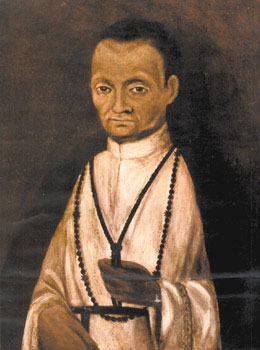
Martín was born at Lima in December 1579 to a Spanish noble father, Don Juan de Porres, and Ana Velázquez, a freed black slave of Panamanian origin (modern scholarship reads her as Afro-Panamanian). The illegitimate child of a mixed-race relationship in the strict caste society of colonial Peru, Martin was abandoned by his father and raised in poverty by his mother. He was apprenticed at twelve to a Lima barber-surgeon and learned the combined trade of barbering and minor surgery that would become his life.
At fifteen he requested admission to the Dominican convent of Santo Rosario in Lima — the largest Dominican house of the New World — initially as a 'donado' (a third-class lay servant) because the Spanish caste laws of the period forbade the admission of mulattos as full religious. He served as donado for nine years before, in 1603, the prior overruled the caste objection and admitted him as a full Dominican lay brother — a deliberate breach of the racial caste boundary that became famous across the order.
He served at Santo Rosario for the remaining thirty-six years of his life. He combined the offices of barber, infirmarian, almoner, and superintendent of the convent's vast medical work in the city — caring for the Spanish, creole, mestizo, mulatto, Andean indigenous, and African populations of Lima with absolute impartiality. He built a major orphanage in the city and an animal hospital at the convent. Mystical phenomena attached to him in his lifetime: bilocations to the Far East and to North Africa (attested by witnesses who said they had been visited by him in places he had never physically left), passing through closed doors, taming animals (the great Lima earthquake of 1606, the convent's rats befriended), and an extraordinary multiplication of food during the Lima famines of the 1620s and 1630s. Close friends with Rose of Lima and Juan Masías. Died at the convent on November 3, 1639. Beatified 1837, canonized 1962 — at the height of the American Civil Rights Movement, an event noted at the time as theologically significant.