
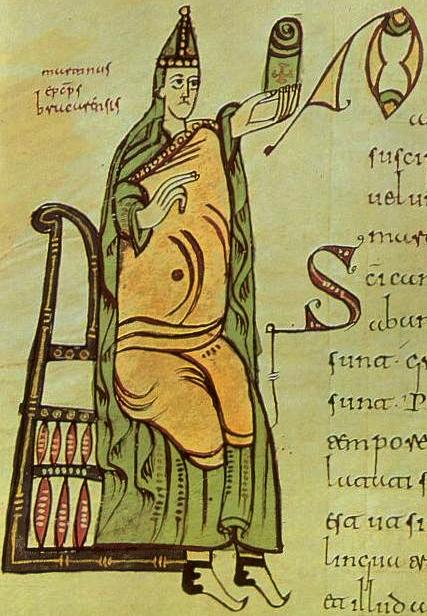
Martin (Latin Martinus) was — per the sources (including Gregory of Tours's contemporary account in his History of the Franks 5.37, and Venantius Fortunatus's poetic letter to Martin) — born in Pannonia around 520 AD. He was educated extensively in Greek and Latin (an unusual combination for a 6th-century Pannonian) and travelled in his youth through Constantinople and the Eastern Mediterranean monastic centres before arriving in northwestern Iberian Galicia around 550 AD.
His pastoral work was the conversion of the Suevi — the Germanic kingdom that had governed Galicia (the northwestern corner of the Iberian peninsula, in what is now northern Portugal and Spanish Galicia) since the early 5th century. The Suevi were Arian Christians; Martin worked through the 550s and 560s to convert the Suevic royal family and the substantial Suevic population to Chalcedonian Catholic Christianity. The conversion was substantially completed during the reign of the Suevic King Theodemar around 560 AD — making the Suevic Kingdom the first Germanic kingdom in the entire Roman tradition to convert from Arianism to Chalcedonian-Catholic Christianity (preceding the more famous Visigothic conversion under Reccared in 587 by some 27 years).
Martin was consecrated Bishop of the small Galician see of Dume around 559, and was elevated to Archbishop of Braga (the metropolitan see of the Suevic Kingdom, and the primatial see of what is now Portugal) around 569. He presided over two Iberian-Catholic councils — the First Council of Braga of 561 and the Second Council of Braga of 572 — which together established the ecclesiastical organization of Catholic-converted Galicia and the Iberian-Suevic Catholic episcopal-disciplinary structure.
He composed extensively in Latin: the De Correctione Rusticorum ('On the Correction of the Peasants') — a sermon-treatise addressing the substantial residual Iberian-Galician pagan religious practices that had persisted into the 6th century, one of the sources for late-antique and early-medieval Iberian-Galician folk religion; and the Formula Vitae Honestae ('Pattern of the Honest Life') — a substantial Latin moral-philosophical treatise drawing extensively on Stoic philosophy (particularly Seneca), which became one of the medieval Latin moral-philosophical handbooks.
He died at Braga on March 20, 580. He is the father of Portuguese Catholic-Christian identity and the early-medieval bridge between Catholic-Patristic Iberian Christianity and the broader Mediterranean Catholic tradition.