
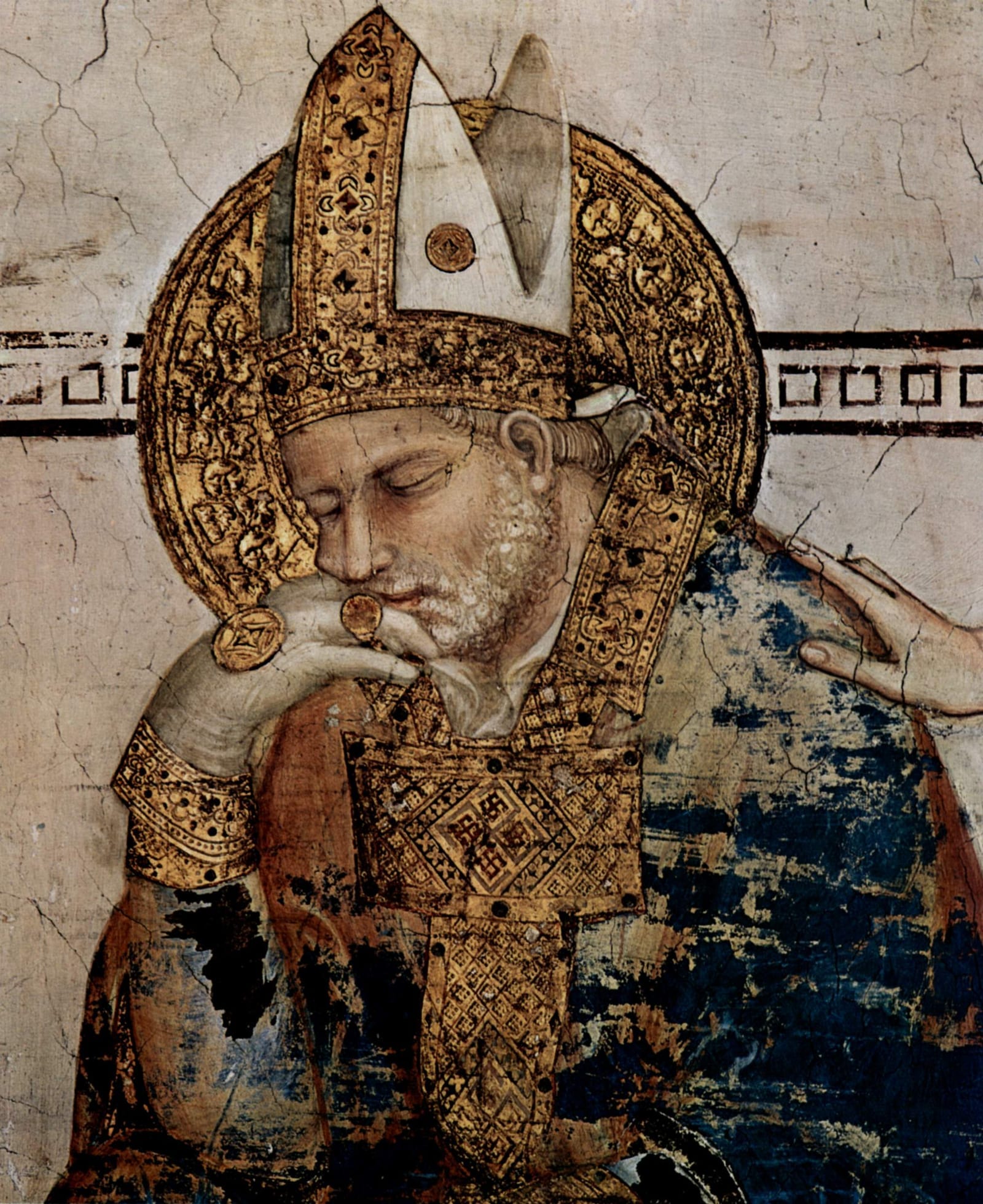
Martin was born to a pagan tribune of the Roman army in what is now western Hungary. Conscripted at fifteen into the imperial cavalry, he was stationed at Amiens. There — in the most famous incident of his life — riding to barracks one winter, he met a half-naked beggar and, having nothing else to give, cut his soldier's cloak in two with his sword and gave half to the beggar. That night Christ appeared to him wearing the half-cloak, saying: 'Martin, who is still a catechumen, has clothed me in this garment.' He was baptized at eighteen.
He refused to fight at the Battle of Worms, declaring himself a soldier of Christ. He served instead under St. Hilary at Poitiers, founded the monastery of Ligugé (361 — the second-oldest in the West), and after Hilary's death was elected bishop of Tours in 371. He founded another great monastery at Marmoutier and led the Christianization of the Gaulish countryside, traveling tirelessly to destroy pagan shrines and replace them with chapels.
His pupil Sulpicius Severus wrote the Life of Martin in Martin's own lifetime — the first major Latin hagiography, the model for every saint's life of the next thousand years. Through it Martin became one of the most-venerated saints of medieval Christendom; some 4,000 churches in France alone bear his name. His half-cloak — the cappa — was carried by the Frankish kings into battle; the small chapel where it was kept (capella) gave the word 'chapel' to every European language.