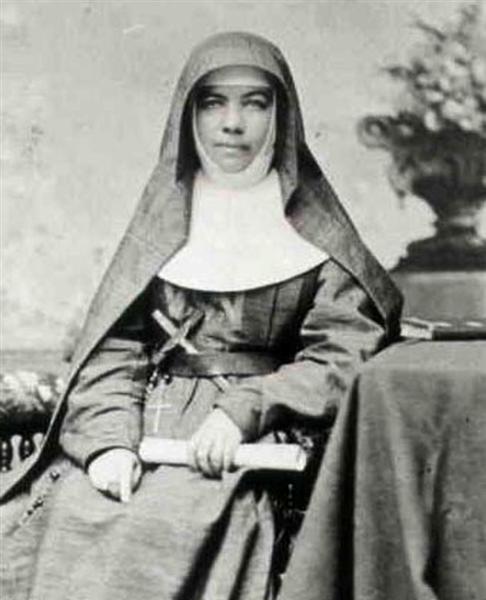
Mary Helen MacKillop was born at Fitzroy, Melbourne, on 15 January 1842, the eldest of the eight children of Scottish immigrants, Alexander and Flora MacKillop. She went to work young — as a shopgirl, a governess, and a teacher at Portland in Victoria — until Fr. Julian Tenison Woods, the parish priest of Penola in South Australia, who wanted to found a religious society to teach the children of the poor in the bush, asked her to begin it with him.
On 19 March 1866, the feast of St. Joseph, they opened a school at Penola in a disused stable. Other women joined her, and the Sisters of St. Joseph of the Sacred Heart — the Josephites — became, in Benedict XVI's words at her canonisation, 'the first women's community of religious sisters' of Australia. The sisters went where the poor were, two or three to a bush township, living as the people around them lived, and they were governed by their own superior general rather than by each bishop — the point on which most of her troubles turned.
On 22 September 1871 Bishop Laurence Sheil of Adelaide excommunicated her 'for alleged insubordination' (Australian Dictionary of Biography), in a quarrel over how the order should be governed, inflamed by clergy hostile to Tenison Woods. It came after the Josephites had reported the alleged abuse of children by a priest of Kapunda, who was sent away; the order's own postulator calls the link to her excommunication 'indirect', and the popular story that she was punished for exposing abuse is not what the sources say. Sheil lifted the sentence on 21 February 1872, days before he died.
In 1873 she went to Rome herself, was received three times by Pius IX, and came home with constitutions approved in 1874; Leo XIII confirmed them in 1888. The cost was a break with Tenison Woods, who could not accept the revision of his Rule. A stroke at Rotorua in New Zealand on 11 May 1901 left her partly paralysed and an invalid for the rest of her life, her mind untouched; she died at North Sydney on 8 August 1909.
Her cause was formally introduced in 1973. John Paul II declared her Venerable on 13 June 1992, approved a first miracle on 6 July 1993, and beatified her in Sydney on 19 January 1995 — 'with gentleness, courage and compassion,' he said, 'she was a herald of the Good News among the isolated "battlers" and the urban slum-dwellers.' Benedict XVI approved a second miracle on 19 December 2009 and canonised her on 17 October 2010. In 2013 she was named second patron of Australia.