
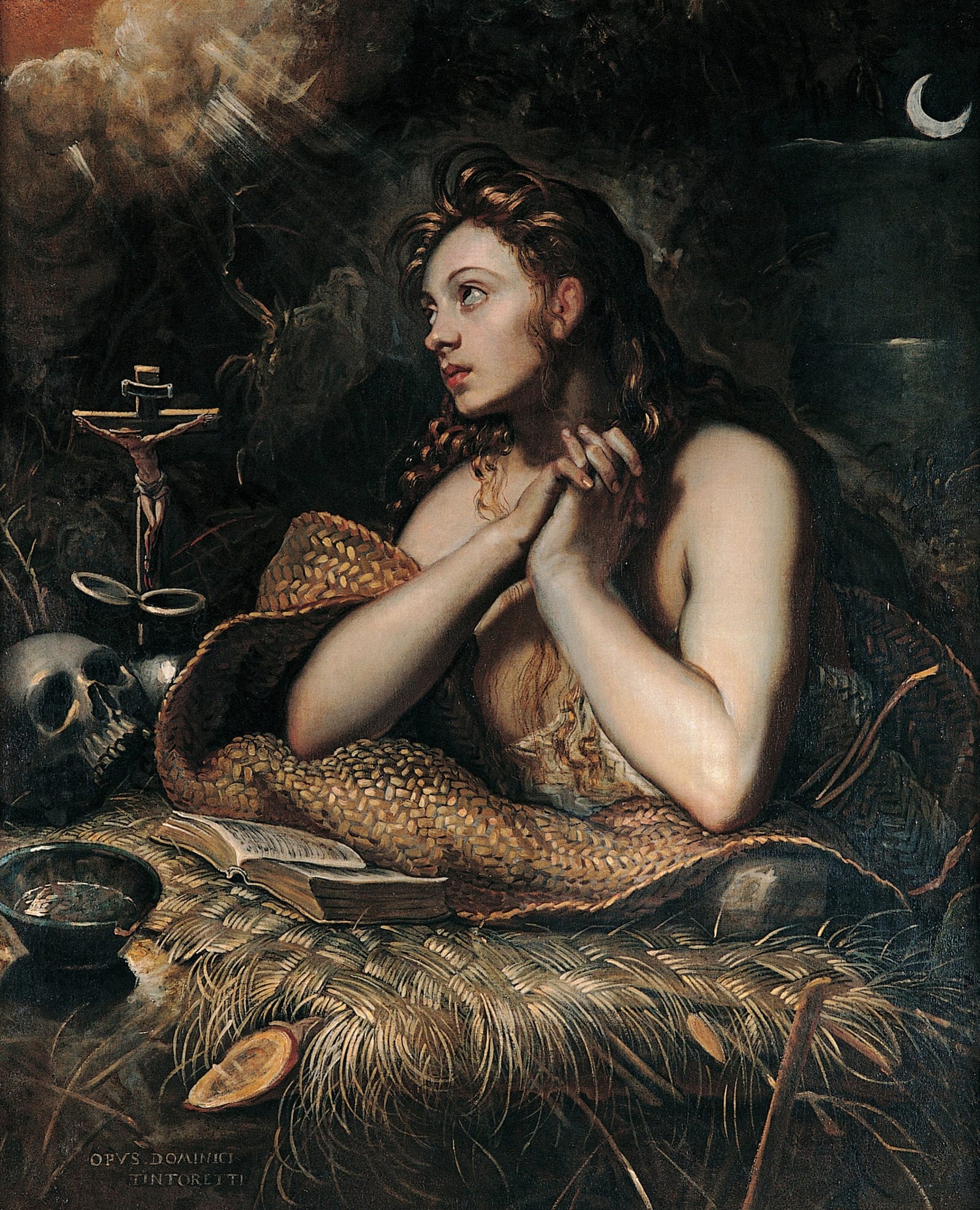
Mary of Magdala on the western shore of the Sea of Galilee is named first among the women who followed Christ — out of whom He had cast seven devils (Lk 8:2; Mk 16:9). She stood with His Mother at the foot of the Cross when the Apostles had fled (Jn 19:25), and was the first witness of the Resurrection on the morning of Easter Sunday (Jn 20:1–18).
Coming to the tomb in the dark with spices, she found the stone rolled away. Running back to Peter and the beloved disciple, she said: 'They have taken away the Lord out of the sepulchre, and we know not where they have laid him.' Returning alone after them, weeping at the tomb, she saw two angels in white. Turning, she saw a man whom she took for the gardener. He said one word: 'Mary.' She knew Him at once: 'Rabboni — Master.' He sent her: 'Go to my brethren, and say to them: I ascend to my Father and to your Father, to my God and your God.'
Western tradition (St. Gregory the Great, 591) conflated her with the sinful woman who anointed Christ's feet at the house of Simon (Lk 7:36–50) and with Mary of Bethany — a conflation now rejected by modern scholarship and by Eastern tradition. Pope Francis in 2016 raised her feast from a memorial to a feast on a par with the Apostles, calling her 'the Apostle to the Apostles' — the first to be sent with the news of the Resurrection.
By Western tradition she ended her days as a hermit in the cave of Sainte-Baume in Provence; by Eastern tradition she lived and died at Ephesus, near St. John.