
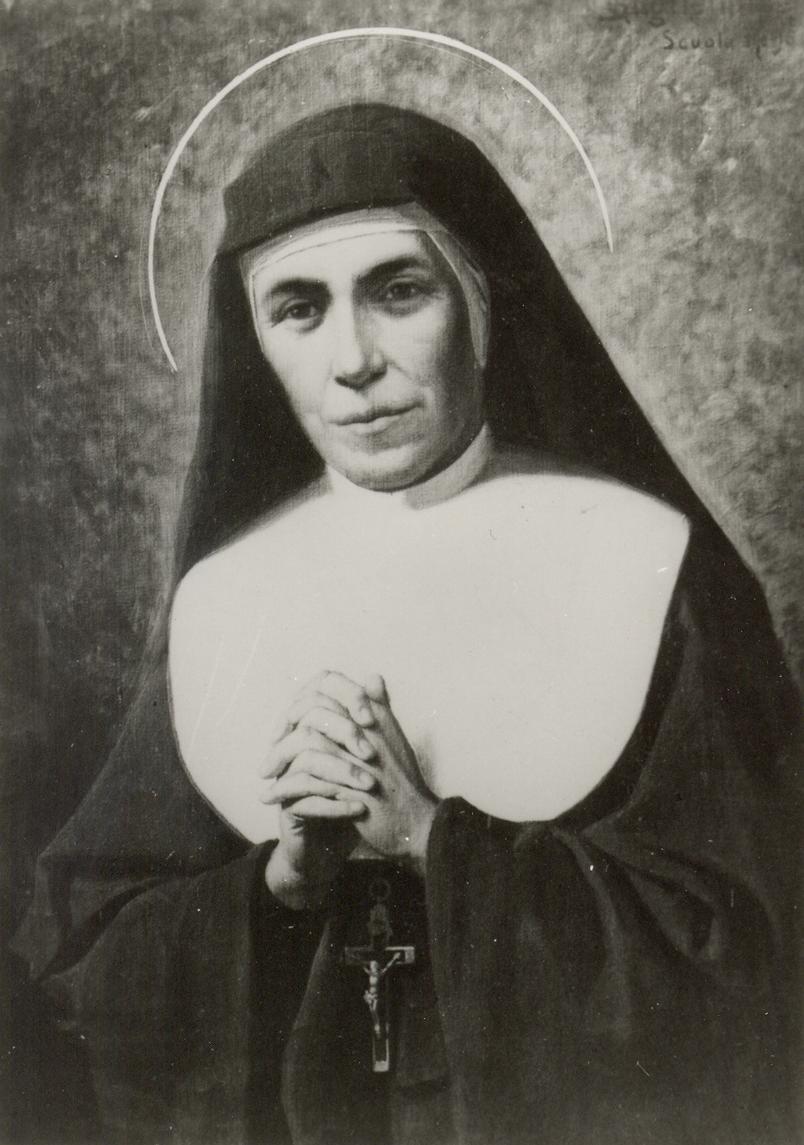
Maria Domenica Mazzarello was born to a small Piedmontese peasant family at the rural village of Mornese in the wine-country hills of the Monferrato region of Piedmont. She worked as a vineyard labourer from childhood — physically robust, intellectually quick, devout. In 1860 — at twenty-three — she contracted typhoid fever during the local epidemic and was left permanently weakened, unable to do hard outdoor field labour. She trained as a dressmaker and from 1862 ran a small dressmaking school for the village girls of Mornese — the seed of her future religious institutional work.
In October 1864 Don Bosco of Turin (see his entry in the 19th-c. catalogue) visited Mornese during a Salesian preaching tour of the Monferrato. He saw the small Mazzarello dressmaking school as the local parallel to his own Turin Salesian Oratory for boys, and from the encounter he began to develop the project of a women's Salesian congregation specifically devoted to the Catholic education of girls — the female parallel to the Salesians for boys he had founded in 1859.
On August 5, 1872 — eight years after Don Bosco's first Mornese visit — Mary Mazzarello and the eleven other young women of the original Mornese community received the religious habit from Bishop Giuseppe Sciandra of Acqui Terme. The new congregation took the title Daughters of Mary Help of Christians (Figlie di Maria Ausiliatrice, FMA — popularly the Salesian Sisters of Don Bosco). Mary Mazzarello was elected first Superior General in 1874 and held the office for the remaining seven years of her life.
Under her direction the Salesian Sisters grew from twelve to over 165 sisters in 26 houses across Italy, France, Argentina, and Uruguay by her death in 1881 — making it the most rapidly-growing Catholic women's religious congregation of the late 19th century. The Salesian Sisters today operate over 1,400 educational institutions in 97 countries and is the largest Catholic women's teaching religious congregation in the world. She died at the Salesian Sisters' new mother-house at Nizza Monferrato on May 14, 1881 at forty-four — of complications of the typhoid weakness she had carried since 1860. Canonized 1951.