
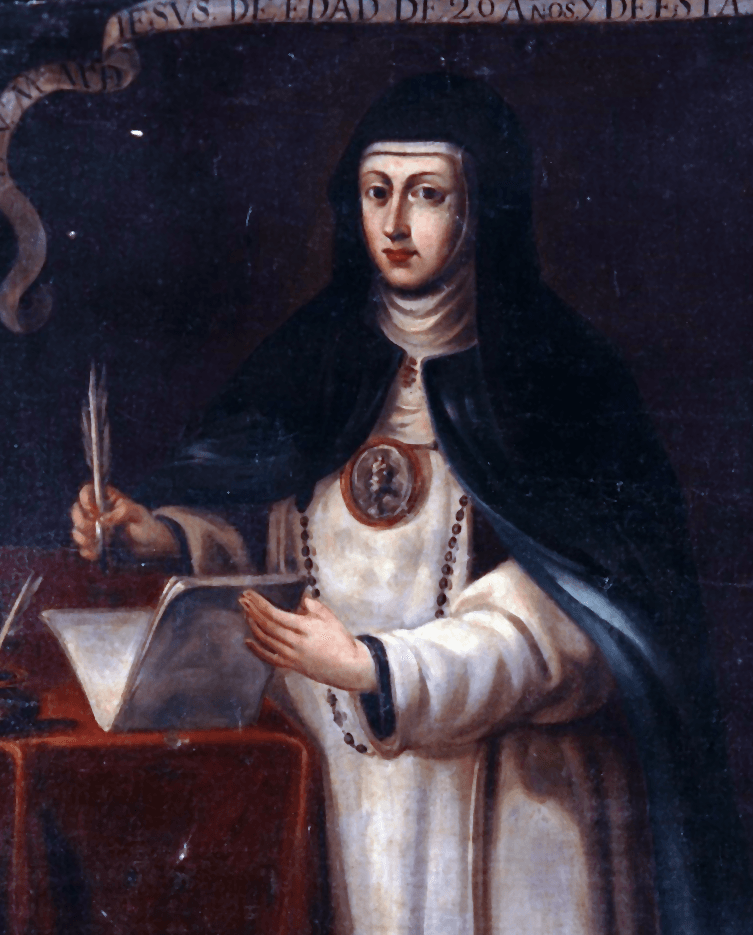
Mary Coronel (religious name María de Jesús de Ágreda) was born on April 2, 1602 at Ágreda to the Coronel family. Her family established the Discalced Franciscan Convent of the Immaculate Conception at Ágreda in 1618 — where Mary and her sister took the habit at the age of 16.
Mary served as abbess of the Ágreda Convent for most of her adult life (elected at age 25 in 1627; served intermittently until her death in 1665).
Mary is most famous in the Catholic tradition for two mystical-visionary phenomena:
1. The Mystical City of God (Mística Ciudad de Dios) — her massive Marian-visionary work composed between 1637 and 1665, the most extensive Marian-mystical literary work of the Catholic tradition. The Mystical City of God narrates the biography of the Blessed Virgin Mary in vivid detail based on Mary's reported visions — producing the 17th-century Catholic Marian devotional-literary tradition.
2. The bilocations to Jumanos — between 1620 and 1631, Mary reported bilocations to the Jumanos indigenous people of modern Texas and New Mexico — where she reportedly appeared as a 'Lady in Blue' (La Dama Azul) in her Discalced Franciscan blue mantle, instructing the Jumanos in the Catholic faith. The bilocations became famous in the Spanish colonial American Catholic tradition when Franciscan missionaries arriving in the New Mexico-Texas territory in 1629 found Jumanos who had already been catechized by the 'Lady in Blue' and were requesting Catholic baptism.
Mary maintained a 22-year personal correspondence with King Philip IV of Spain (1621–1665) — the famous Ágreda-Philip IV correspondence (over 600 surviving letters, serving as personal spiritual and political counsel to the Spanish Habsburg monarch during the Grand Siècle crisis).
She died at Ágreda on May 24, 1665 at the age of 63.