
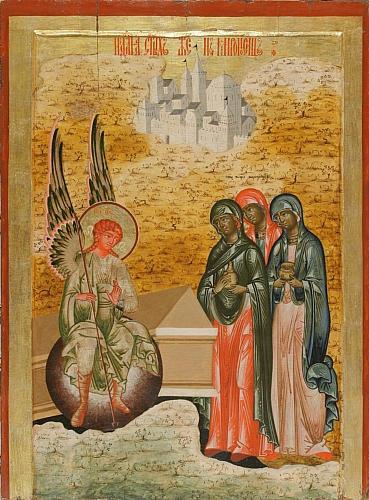
Salome (Hebrew Shalom, 'peace') was the wife of Zebedee — a Galilean fisherman of Bethsaida or Capernaum who employed his sons James and John in his fishing business (Mark 1:20). She was the mother of the apostles James the Greater and John the Evangelist (Matthew 27:56, Mark 15:40, 16:1). Comparison of John 19:25 with the synoptic lists strongly suggests that she was the sister of the Blessed Virgin Mary — making James and John first cousins of the Lord on the maternal side.
She is the woman who came to Jesus on his last journey to Jerusalem to ask that her two sons be seated at his right and left in the Kingdom (Matthew 20:20–23) — Jesus's gentle reproof of her request ('You know not what you ask… Can you drink of the chalice that I shall drink?') became one of the foundational New Testament texts on the cost of apostleship and the priority of the Cross over royal precedence.
She was one of the women at the foot of the Cross (Mark 15:40) and one of the Myrrh-Bearing Women who came to the tomb on Easter morning to anoint the body of Jesus and found it empty (Mark 16:1). The Provençal tradition (see Mary of Cleophas above) holds that Salome — together with Mary of Cleophas, Mary Magdalene, Lazarus, Martha, Maximin, and Sara — sailed from Palestine to the Camargue after the Resurrection and ended her life at the small marsh-town now called Saintes-Maries-de-la-Mer ('Holy Marys of the Sea').