
MIRACULOUS MIRACLES™

Saint — Mathilda of Saxony

St. Mathilda of Saxony
c. 895 AD, Enger, Saxony (noble Westphalian-Saxon family) — March 14, 968 AD, Quedlinburg Abbey, Saxony
Queen of Germany (909–936); mother of Emperor Otto I the Great
Quedlinburg Abbey (Stift Quedlinburg), Saxony-Anhalt, Germany — her foundation of 936; the Ottonian women's abbey, in continuous use 936 to present (now Protestant Lutheran), Germany
Feast
March 14
Canonized
Pre-congregation; cult established immediately at Quedlinburg
Life

Mathilda was born around 895 to the Westphalian Saxon count Dietrich and his wife Reinhild — descended from the legendary Saxon hero Widukind (the Saxon resistance leader against Charlemagne, baptized in 785).

Around 909, at the age of 14, she was married to Henry, Duke of Saxony (the future Henry I the Fowler) — a dynastic marriage uniting the Saxon and Westphalian Carolingian-aristocratic kindreds. In 919, with the death of Conrad I, Henry was elected King of the East Franks (Germany) — making Mathilda the queen of the nascent East Frankish (German) kingdom.

She and Henry produced five royal children: Otto I the Great (the future Holy Roman Emperor, 936–973), Henry I the Quarrelsome (Duke of Bavaria), Bruno the Great (Archbishop of Cologne, saint), Gerberga of Saxony (Queen of West Francia, mother of King Lothair), and Hedwig of Saxony (Duchess of the Franks, mother of the Capetian dynasty's founder Hugh Capet). The Saxon royal dynasty that Mathilda bore would shape the entire 10th–11th-century European political order.

On Henry's death in 936, the political tension between her sons Otto and Henry over the succession — and Mathilda's personal preference for the younger Henry — produced political-familial conflict. Otto was elected king (and later crowned Emperor in 962). Otto's queen Edith (daughter of Edward the Elder of England) was Mathilda's daughter-in-law; their relationship was complex, with Mathilda undergoing brief political exile from the court before being restored.

In her widowhood, Mathilda founded multiple monastic communities — most the Quedlinburg Abbey in Saxony (936, on the site of Henry's royal palace) and the Nordhausen Abbey, placing them under the governance of her granddaughters and royal kinswomen. The Quedlinburg Abbey became the principal Ottonian royal women's-monastic foundation, housing the royal Ottonian nuns and the royal genealogical-and-liturgical traditions.

She died at Quedlinburg on March 14, 968, having outlived her husband by thirty-two years.

Miracles & Phenomena
  • The Ottonian royal family

    Mathilda's maternal bearing and raising of the five Ottonian royal children — Emperor Otto I the Great, Duke Henry I of Bavaria, Archbishop St. Bruno the Great of Cologne, Queen Gerberga of West Francia (mother of King Lothair), and Duchess Hedwig of the Franks (mother of King Hugh Capet of France) — produced the royal family that would shape the entire 10th-11th-century European political-ecclesiastical order. The consequence — Ottonian Empire, Saxon-Imperial coronation of 962, Investiture controversy, Cluniac reform, French Capetian dynasty — flows from the Mathilda maternal mission.

  • The Quedlinburg Abbey (936)

    Mathilda's foundation of Quedlinburg Abbey in 936 — on the site of her husband Henry's royal palace, at the request of her son Otto I — produced the principal Ottonian women's-monastic foundation, the royal-imperial necropolis (where Mathilda, Henry, and multiple Ottonian royal kindred were buried), and the longest-running women's monastic community in Saxony. The abbey survives — now Protestant Lutheran — in continuous use to the present day, with the Romanesque collegiate church of St. Servatius preserved as an UNESCO World Heritage Site (inscribed 1994, together with the old town of Quedlinburg).

Relics
  • Body
    Tomb of St. Mathilda
    Collegiate Church of St. Servatius (Stiftskirche St. Servatius), Quedlinburg, Saxony-Anhalt, Germany — in the crypt alongside her husband Henry the Fowler; UNESCO World Heritage Site since 1994

    Her tomb in the Romanesque collegiate church of St. Servatius at Quedlinburg has been venerated for over a thousand years. The church (now Protestant Lutheran since the Reformation) survives in continuous use as an UNESCO World Heritage Site; the Ottonian royal crypt with the tombs of Mathilda and Henry the Fowler remains accessible.

Iconography
  • Mathilda founding Quedlinburg Abbey

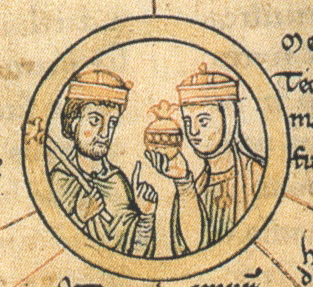
    The early-10th-century Queen of Germany in Ottonian royal regalia at the palace-site of Quedlinburg in 936 receiving the foundation-charter from her son Emperor Otto I, the construction of the abbey-church visible behind, her deceased husband Henry the Fowler's royal sword laid on the ground — the iconography of Catholic Ottonian queen-saint tradition.

Patronages
Catholic Ottonian queen-saint traditionThe Saxon region of Quedlinburg, Magdeburg, and GoslarCatholic widows of royal familiesCatholic mothers of large royal familiesCatholic women's monastic founders