
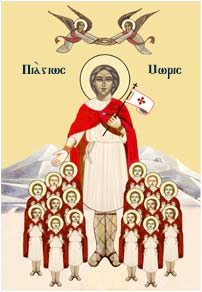
Maurice (Latin Mauricius) was — per the foundational 5th-century Passion of the Martyrs of Agaunum by Bishop Eucherius of Lyon — the commander (primicerius) of the Theban Legion, a Roman legion of 6,600 men recruited from Upper Egypt under the late-3rd-century Roman recruitment system that drew specifically from the Greek-Coptic Christian population of the Thebaid (the great Christian region around Thebes/Luxor in Upper Egypt).
Around 286 AD, the Emperor Maximian (co-emperor with Diocletian) was leading an imperial campaign in the Rhone valley against the Bagaudae (a peasant-revolutionary movement of late-Roman Gaul). The Theban Legion was ordered as part of the larger Roman army to camp at Agaunum (the modern Saint-Maurice in the Swiss canton of Valais, at the southern foot of the Great St. Bernard Pass) and was commanded to participate in a great pagan sacrifice to the Roman gods of victory before the next stage of the campaign — and additionally to suppress the local Christian community of the area.
Maurice and his Theban Legion — entirely Coptic Christians — formally refused both orders. Maximian ordered the Legion decimated (every tenth man killed). Maurice and the survivors still refused. The Emperor ordered a second decimation. They still refused. The Emperor finally ordered the entire 6,600-man legion executed at Agaunum.
The historical reliability of the Eucherius narrative has been much debated — modern critical scholarship has questioned the scale (an entire 6,600-man legion is a substantial proportion of the available imperial forces, and contemporary sources do not record the loss) — but the foundational fact of a Christian-soldier martyrdom at Agaunum in the late 3rd century is firmly attested, and the Abbey of Saint-Maurice (founded by Bishop Theodore of Octodurum in 380 over the original mass-burial site) has continuously preserved the cult for over 1,600 years. The Abbey is the oldest continuously-inhabited monastery in Western Europe and one of the great foundation-shrines of Swiss and Western European Catholicism.