
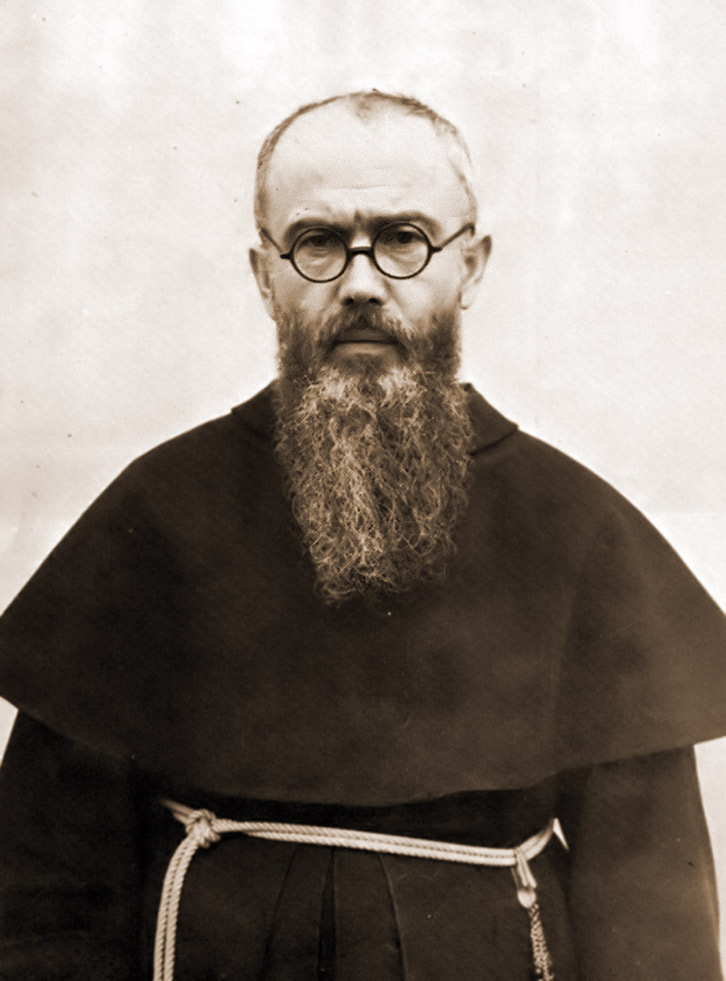
Raymond Kolbe was born in Russian-ruled Poland to a poor weaving family. At about twelve, after a misbehaviour, he experienced a vision of the Blessed Virgin offering him two crowns — a white one for purity and a red one for martyrdom. He asked for both. He entered the Conventual Franciscans in 1907, took the name Maximilian, was ordained in Rome in 1918.
Convinced that the modern world needed Mary as its battle-standard, he founded the Militia of the Immaculata, a movement of total Marian consecration, in 1917. Back in Poland he established Niepokalanów ('City of the Immaculate') — a vast monastic publishing complex with its own train station, fire brigade, and amateur radio station. Its flagship Marian journal Rycerz Niepokalanej reached a circulation of nearly a million.
In 1930 he founded a sister mission at Mugenzai no Sono near Nagasaki, Japan — on a hillside whose location would later spare it from the worst of the 1945 atomic bombing. After returning to Poland and the German invasion in 1939, he was briefly arrested, released, and sheltered some 2,000 Jewish refugees and Polish nationals at Niepokalanów.
He was arrested again on February 17, 1941, and sent to Auschwitz on May 28 as prisoner 16670. On July 29, after a prisoner escaped from his block, ten men were chosen at random to die of starvation as punishment. When Franciszek Gajowniczek, a young husband and father, cried out in grief for his wife and children, Maximilian stepped forward and asked to take his place. The Lagerführer assented. After two weeks of starvation, the four still alive — Kolbe last among them — were killed by lethal phenol injection on the vigil of the Assumption, August 14, 1941. He was canonised in 1982 by John Paul II. Gajowniczek, who survived the war, was present at both his beatification and canonisation.