
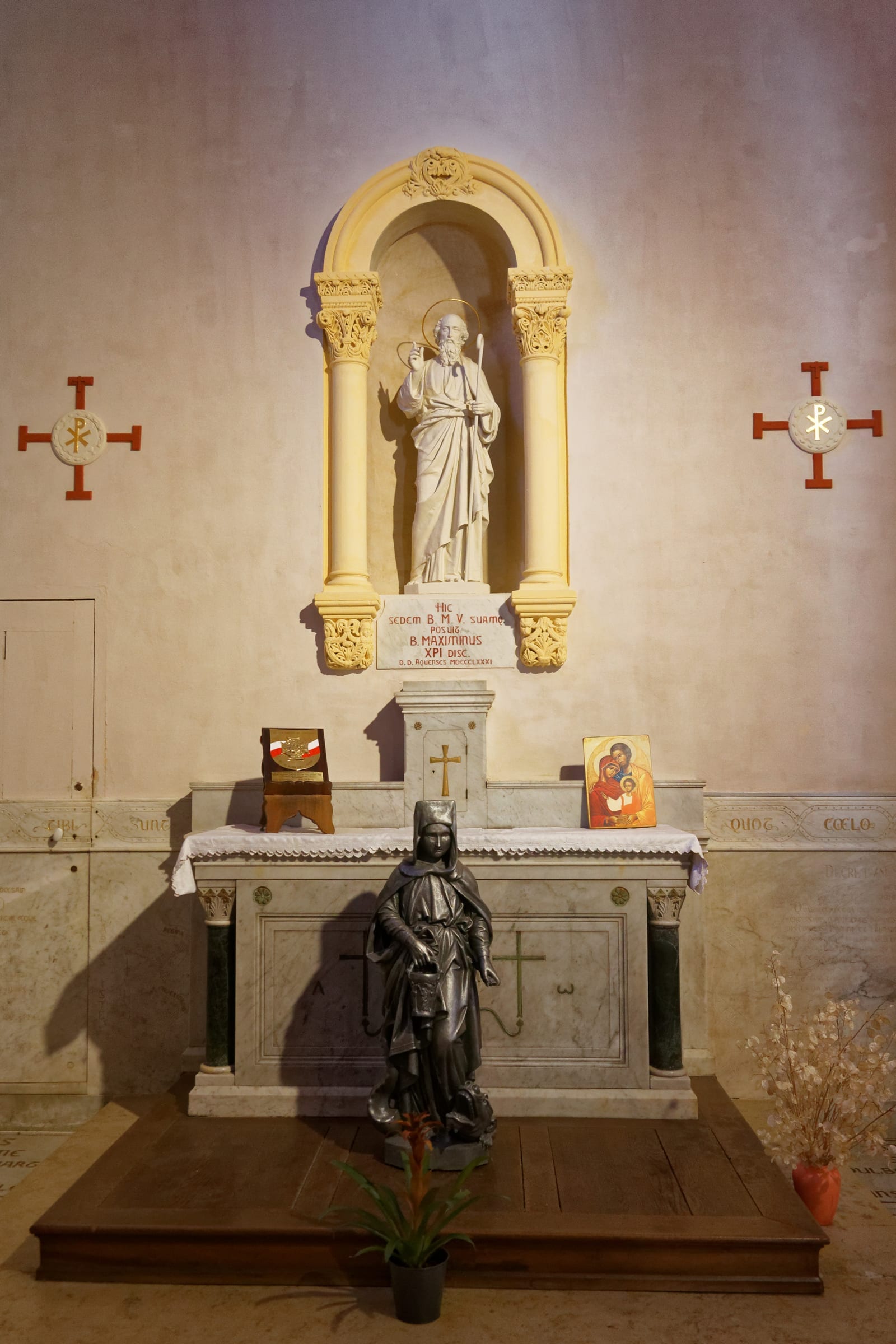
Maximin (Latin Maximinus) is venerated in the Provençal Catholic tradition as one of the Seventy Disciples sent by Christ (Luke 10) and as the central male figure of the apostolic group that — per the Provençal tradition — sailed without sail or oar from Palestine to the southern coast of Gaul in the years after the Resurrection, landing at the Camargue marshes. The group included (per the standard 11th-century version of the tradition): Lazarus, Martha, Mary Magdalene, Mary of Cleophas, Mary Salome, Sara the Egyptian, and Maximin himself.
Maximin and Mary Magdalene proceeded inland from the Camargue to the area east of Marseille that became Aix-en-Provence, where Maximin was established as first bishop. Mary Magdalene retired to live in solitary contemplation at the cave called La Sainte-Baume (the 'Holy Cave') in the limestone cliffs east of Aix. Maximin served as Mary Magdalene's spiritual director and brought her Communion regularly through her thirty years in the cave; at the moment of her death he travelled to the cave to receive her last sacraments and to bury her at the small chapel of Saint-Maximin near Aix.
The remarkable 13th-century Gothic basilica of Saint Mary Magdalene at Saint-Maximin-la-Sainte-Baume — one of the principal Gothic cathedrals of southern France — preserves what tradition holds is the burial-cave of Mary Magdalene and Maximin together. The skull of Mary Magdalene, preserved in a gold reliquary in the basilica crypt, is one of the principal Catholic relics of southern France. The historical accuracy of the Provençal-apostolic tradition is much debated by modern scholarship — though the substantial physical and devotional reality of the Provençal cult at Saint-Maximin and La Sainte-Baume from at least the 11th century is unquestioned.