
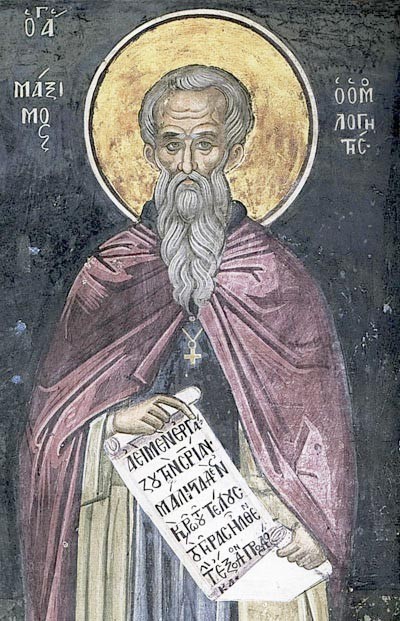
Maximus was head of the imperial chancellery of Heraclius at Constantinople before, around 614, abandoning his career to become a monk at Chrysopolis on the Asian shore of the Bosphorus. Driven from Constantinople by the Persian advance, he settled in North Africa and then in Rome.
From the 640s onward he was the central theological figure of the resistance to Monothelitism. With Pope Martin I he led the Lateran Synod of 649 that condemned the heresy and the imperial edicts supporting it. The Emperor Constans II had both arrested. Maximus was tortured at length to force him to recant; refusing, he was condemned in 662 to have his tongue cut out and his right hand cut off, then exiled to a remote fortress in the Caucasus, where he died a few weeks later.
His theological corpus — the Ambigua, Mystagogia, the Questions to Thalassius — is the supreme synthesis of Greek patristic theology before John Damascene. He developed a Christology of two wills, two natural energies, and a single Person; a cosmology of the Logos as the unifying principle of all reality; and a mystical theology of the soul's deification. Pope Honorius III in 1227 listed him with the four Greek Doctors; modern Eastern Orthodoxy ranks him among the greatest of all the Fathers.