
MIRACULOUS MIRACLES™

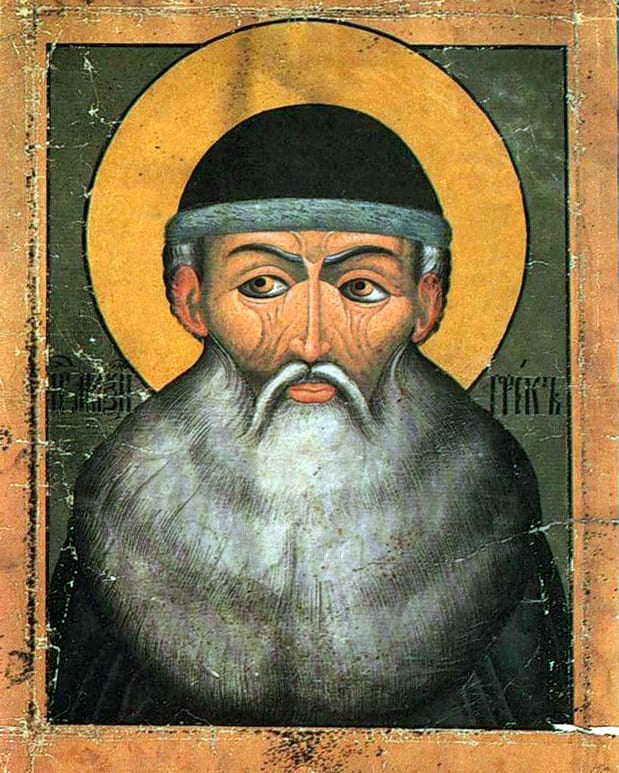
Saint — Maximus the Greek

St. Maximus the Greek
c. 1475 AD, Arta, Epirus, Byzantine Despotate of Epirus (Trivolis family) — January 21, 1556 AD, Holy Trinity-Sergius Lavra, Tsardom of Russia
Greek Athonite monk; Russian biblical-liturgical translator and reformer
Holy Trinity-Sergius Lavra, Sergiyev Posad, Russia — his tomb; UNESCO World Heritage Site, Russia
Feast
January 21
Canonized
Canonized 1988 by the Russian Orthodox Church
Life

Michael Trivolis (Russian religious name Maxim / Maximus) was born around 1475 at Arta in Epirus to a Greek noble family. Educated at the Renaissance humanist circles of Florence and Venice — including personal study under Angelo Poliziano, Marsilio Ficino, and the Aldine Press circle of Aldus Manutius — Maximus received one of the most extensive late-Renaissance-humanist educations of any contemporary.

In 1502 he entered the Mount Athos Monastery of Vatopedi — undertaking the Athonite monastic vocation under the religious name Maximus.

In 1516, Grand Prince Vasily III of Moscow requested the Ecumenical Patriarch of Constantinople to send a Greek scholar-monk to Moscow to undertake the systematic revision of the Slavonic biblical and liturgical texts. Maximus was sent — arriving in Moscow in 1518.

Maximus undertook the systematic revision of the Slavonic biblical translations (the Psalter, the Gospels, and multiple liturgical books) — producing the most comprehensive late-medieval revision of the Church Slavonic biblical corpus.

His reforming project provoked opposition from the conservative Russian monastic party — most notably Metropolitan Daniel, who objected to Maximus's textual corrections as corruption of the received Slavonic tradition.

In 1525 Maximus was condemned by a Muscovite ecclesiastical court on trumped-up heresy charges and imprisoned at the Volokolamsk Monastery for the six years. Further condemned in 1531, Maximus spent the 25+ years in monastic imprisonment across multiple Russian monasteries.

In 1553 he was released to the Holy Trinity-Sergius Lavra, where he spent his last three years of relative freedom. He died at the Lavra on January 21, 1556 at the age of approximately 81.

Canonized in 1988 by the Russian Orthodox Church — at the millennium celebration of the baptism of Kievan Rus'.

Miracles & Phenomena
  • The Slavonic biblical-textual revision

    St. Maximus the Greek's systematic revision of the Slavonic biblical translations (the Psalter, Gospels, and multiple liturgical books) at Moscow 1518–1525 — producing the most comprehensive late-medieval revision of the Church Slavonic biblical corpus — established the textual-critical scholarly tradition in the Russian Catholic-Orthodox tradition. Despite his 30-year imprisonment, Maximus's textual corrections underpinned the Nikonian liturgical reform of the mid-17th century (the Patriarch Nikon reforms that produced the Old Believer schism).

Relics
  • Body
    Relics of St. Maximus the Greek
    Holy Trinity-Sergius Lavra, Sergiyev Posad, Russia — UNESCO World Heritage Site

    His relics rest at the Holy Trinity-Sergius Lavra in continuous Russian Catholic-Orthodox veneration.

Iconography
  • Maximus at the Trinity Lavra scriptorium

    The late-15th and mid-16th-century Greek-Athonite monk-scholar in Athonite monastic schema-habit at the Trinity Lavra scriptorium revising the Slavonic biblical translations — the iconography of Catholic-Orthodox Russian textual-critical biblical tradition.

Patronages
The Russian, Ukrainian, and Belarusian Catholic-Orthodox traditionCatholic Athonite-Greek Russian biblical-translation traditionCatholic confessors of monastic-liturgical reform