
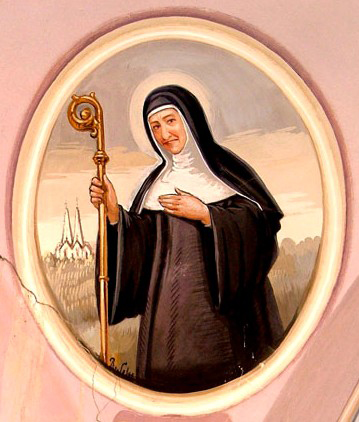
Mechtilde of Hackeborn was the younger sister of the abbess Gertrude of Hackeborn, who in 1258 transferred the family-founded Cistercian community of Rodalsdorf to Helfta. Under Gertrude's forty-year abbacy Helfta became the most learned women's monastery of medieval Germany — its library held works of Hugh and Richard of Saint-Victor, Bonaventure, Aquinas, and the entire range of Dominican scholastic theology.
Mechtilde served as cantor (chant mistress), educator of the choir, and mistress of the children given over for monastic upbringing — including the young Gertrude the Great. Her mystical experiences began in childhood and continued in choir throughout her life. They were recorded by Gertrude the Great and another sister in the Liber Specialis Gratiae ('Book of Special Grace'), one of the foundational Sacred Heart and Eucharistic mystical texts of medieval Christianity.
Her visions centered on the Heart of Christ — long before the Visitation revelations to Margaret Mary Alacoque four centuries later — and on the Eucharist as the meeting-place of the Heart of Christ with the heart of the soul. Dante, in Purgatorio xxxiii, calls the woman who appears at the river Eunoe 'Matelda' — most modern scholars identify this as Mechtilde of Hackeborn. She died at Helfta in November 1298.