
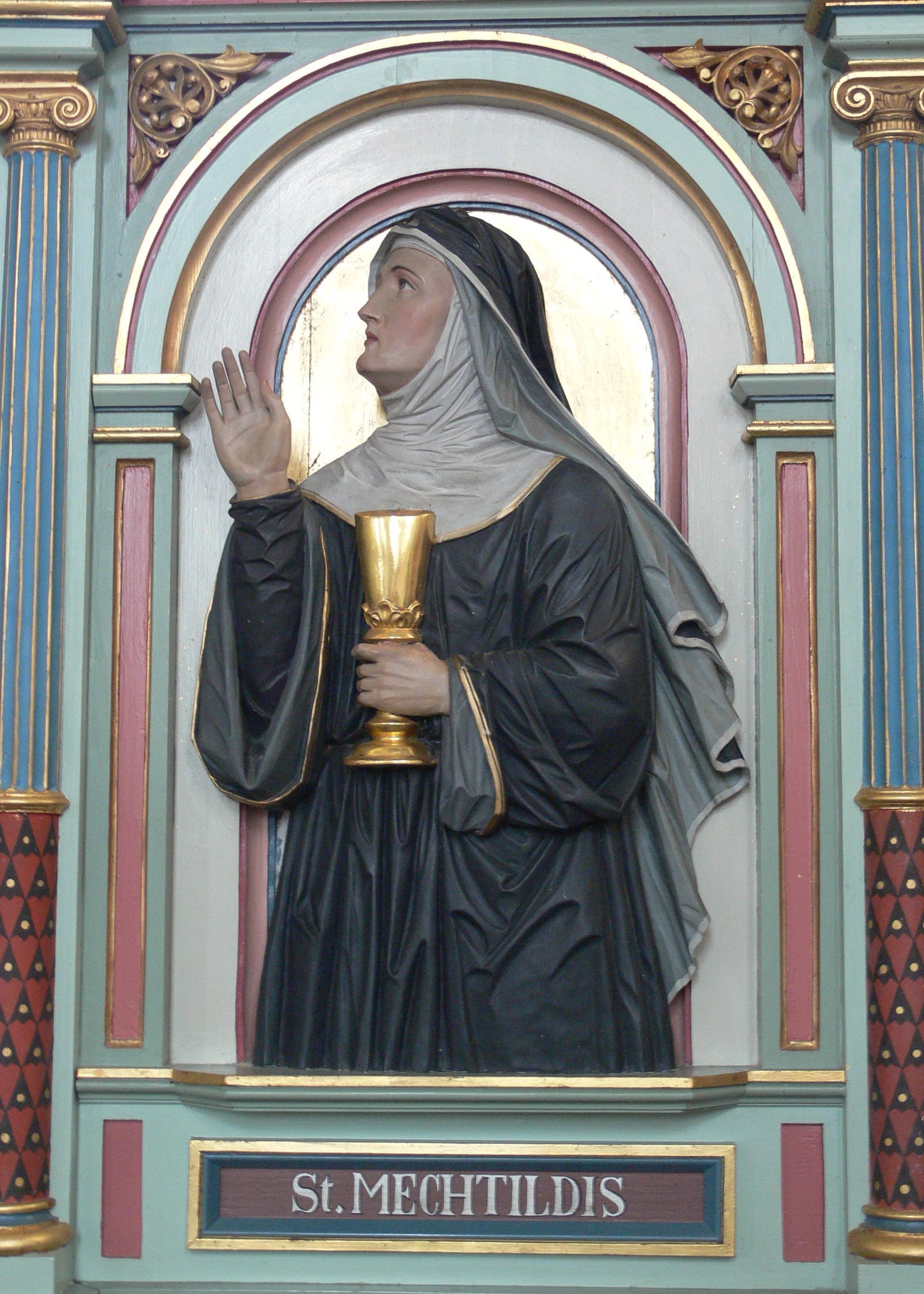
Mechtilde was born to a noble Saxon family but at twenty-three left her home to live as a Beguine at Magdeburg — the unenclosed lay-religious life pioneered a generation earlier by Marie of Oignies. She lived in poverty in the city for forty years under the spiritual direction of the Dominican Heinrich of Halle.
From around 1250 she began writing — in Middle Low German, not Latin — the long mystical work Das fließende Licht der Gottheit ('The Flowing Light of the Godhead'). The seven-book work is one of the earliest substantial works of German vernacular prose and the foundational text of the German mystical tradition: a fiercely personal, image-saturated, sometimes erotic dialogue between the soul and God, with bitter prophetic denunciation of corrupt clergy that drew dangerous accusations of heresy. Some scholars hold that Dante drew indirectly on her work for the imagery of his Paradiso (the precise lines of influence are debated).
Old, blind, and exhausted by harassment from Magdeburg clergy, in 1270 she retired to the great Cistercian abbey of Helfta near Eisleben, then under the abbess Gertrude of Hackeborn. There she completed her work in conditions of safety, alongside two other great mystics, Mechtilde of Hackeborn and Gertrude the Great. She died at Helfta around 1282 and is venerated as Blessed.