
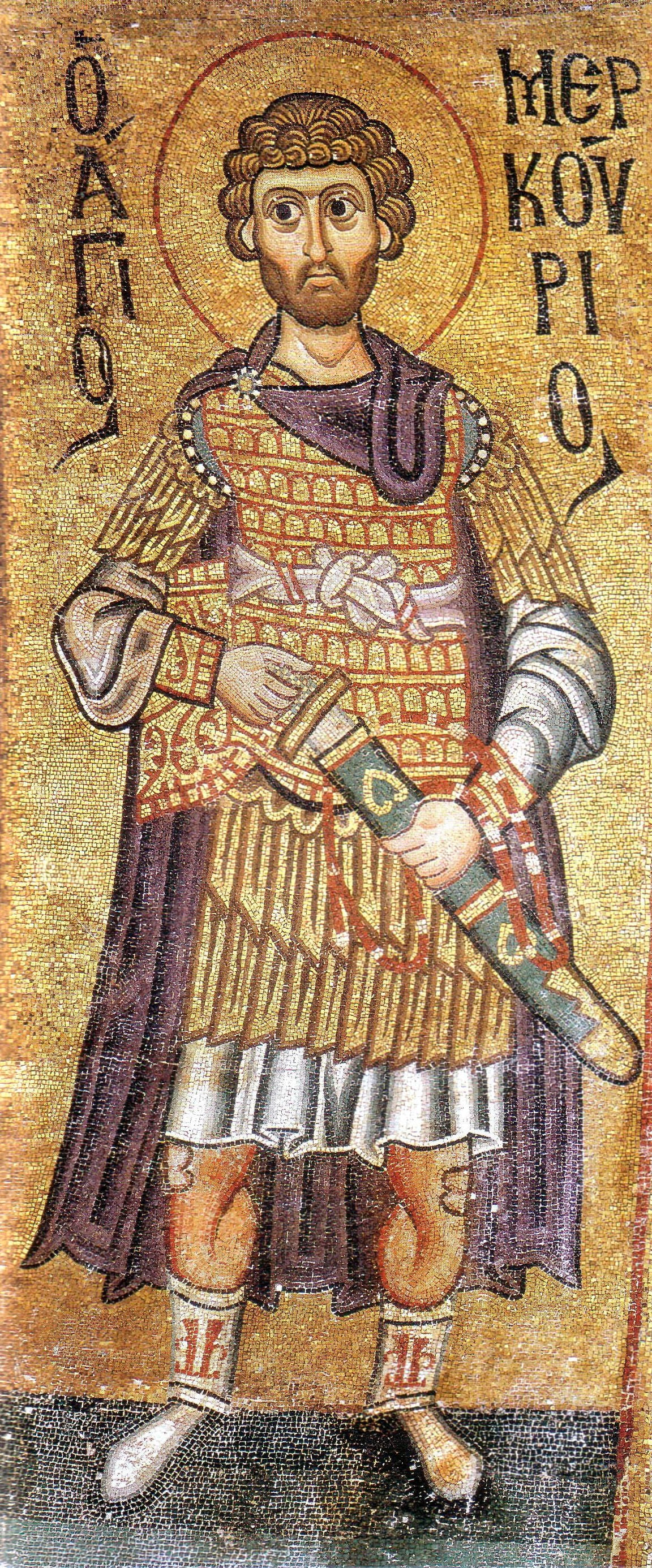
Mercurius (Greek Merkourios) was — per the universal Eastern tradition (Greek, Coptic, Ethiopian, Armenian, Slavic) — a young Cappadocian Roman soldier of the late 3rd century, of Scythian origin. He served as a tribune in the Roman Legion of the Martisii during the Persian wars of the Emperor Decius (249–251). According to the tradition, during a difficult battle against the Persians Mercurius received a visit from the Archangel Michael, who gave him a second sword (in addition to his Roman gladius) — the so-called 'sword of the angel' — and through whose miraculous aid he killed the enemy commander and won the battle. Hence his title 'Mercurius of the Two Swords.'
He was promoted by Decius for the victory but, when summoned to the imperial public sacrifice in gratitude to the pagan gods of victory, he refused to participate and confessed his Christianity. Decius personally interrogated him and, after extended torture (the Coptic Acts describe twelve days of progressively brutal methods), had him beheaded at Caesarea Cappadocia.
He is venerated as one of the great soldier-martyrs of the Eastern Christian tradition (with George, Demetrius, Theodore, and Sergius and Bacchus). The most famous medieval tradition: at the 363 death of the Emperor Julian the Apostate (who had been killed by an unknown arrow during his Persian campaign), Basil of Caesarea received a vision in which he saw Mercurius — at the prayer of the Virgin Mary — riding from his Cappadocian tomb to Persia, killing Julian with the angel-sword, and returning. The story is preserved in Sozomen's Church History (5.2) and made the cult of Mercurius the iconic Christian story of providential vindication against the apostate emperor.