
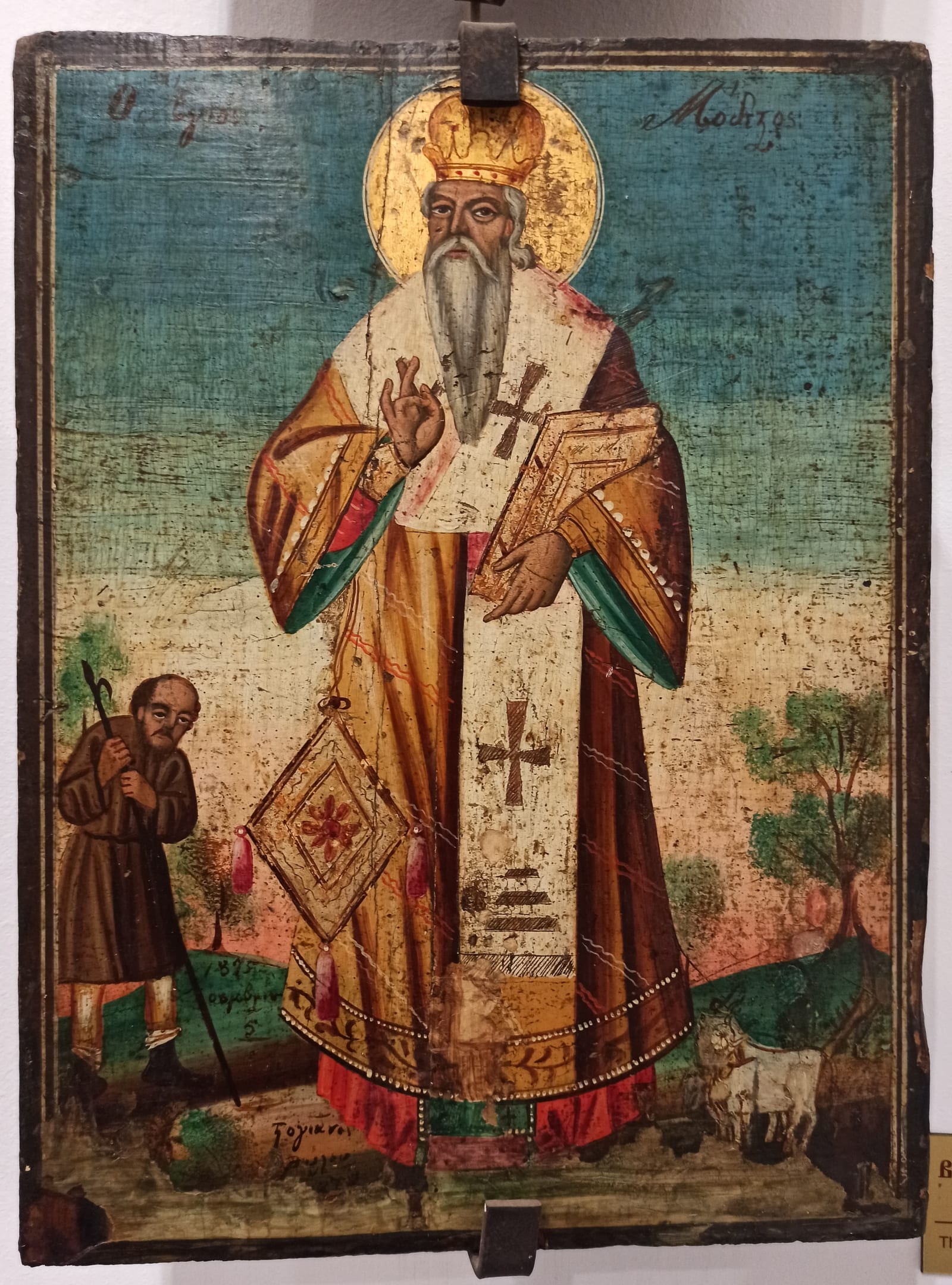
Modestus (Latin Modestus) was a Palestinian Catholic monk who served at the Patriarchate of Jerusalem in the years immediately following the catastrophic Persian sack of Jerusalem of May 614. The Persian sack had killed substantial portions of the Jerusalem Christian population, had destroyed or substantially damaged the great Catholic churches of Jerusalem (including the foundational Constantinian Church of the Holy Sepulchre, the Eleona Church on the Mount of Olives, and the Church of the Holy Cross), and had carried off the relic of the True Cross to Persia (see Anastasius the Persian's entry above for the broader catastrophic context).
Modestus served from 614 onwards — initially under the Patriarch Zacharias who had been carried off to Persia as a captive, and from 631 as Patriarch himself — as the principal director of the substantial post-Persian-sack restoration of the Christian Holy Places. The restoration was financed substantially by Modestus's personal contacts with Patriarch John the Almsgiver of Alexandria (see John the Almsgiver's entry already in the catalogue), who sent substantial financial support, food relief, and skilled artisans to support the Jerusalem restoration.
Modestus's principal architectural project — the substantial rebuilding of the Constantinian Church of the Holy Sepulchre — was completed by 626 AD. The Modestian rebuilding preserved the foundational Constantinian basic plan (the great rotunda over the Edicule of the Tomb of Christ, the eastern basilica-nave over the rock of Calvary) but introduced substantial early-Byzantine architectural elements. The Modestian Holy Sepulchre stood until the catastrophic 1009 destruction by Caliph al-Hakim — the foundational late-medieval Holy Sepulchre that the medieval Catholic pilgrims of the Crusader period would rebuild as the present Crusader-period basilica.
Modestus was elected formal Patriarch of Jerusalem after the death of his predecessor and the eventual return of the surviving Jerusalem Catholic infrastructure. He governed the Patriarchate for the four years 630–634, through the foundational return of the True Cross to Jerusalem by the Emperor Heraclius on March 21, 630 — the great feast of the Exaltation of the Holy Cross that has been continuously celebrated by the universal Catholic Church on September 14 ever since (commemorating the return of the True Cross to Jerusalem in the post-Persian-war restoration). Modestus presided personally over the Heraclian return of the True Cross to Jerusalem.
He died at Jerusalem on December 16, 634 — six months before the Arab-Muslim conquest of Jerusalem of 638 (the catastrophic event that would end the late-antique Christian governance of the Holy Land for the next 1,360 years until the modern period). His successor as Patriarch of Jerusalem was Sophronius (see Sophronius's entry already in the catalogue), who would preside over the surrender of Jerusalem to the Caliph Umar in 638.