
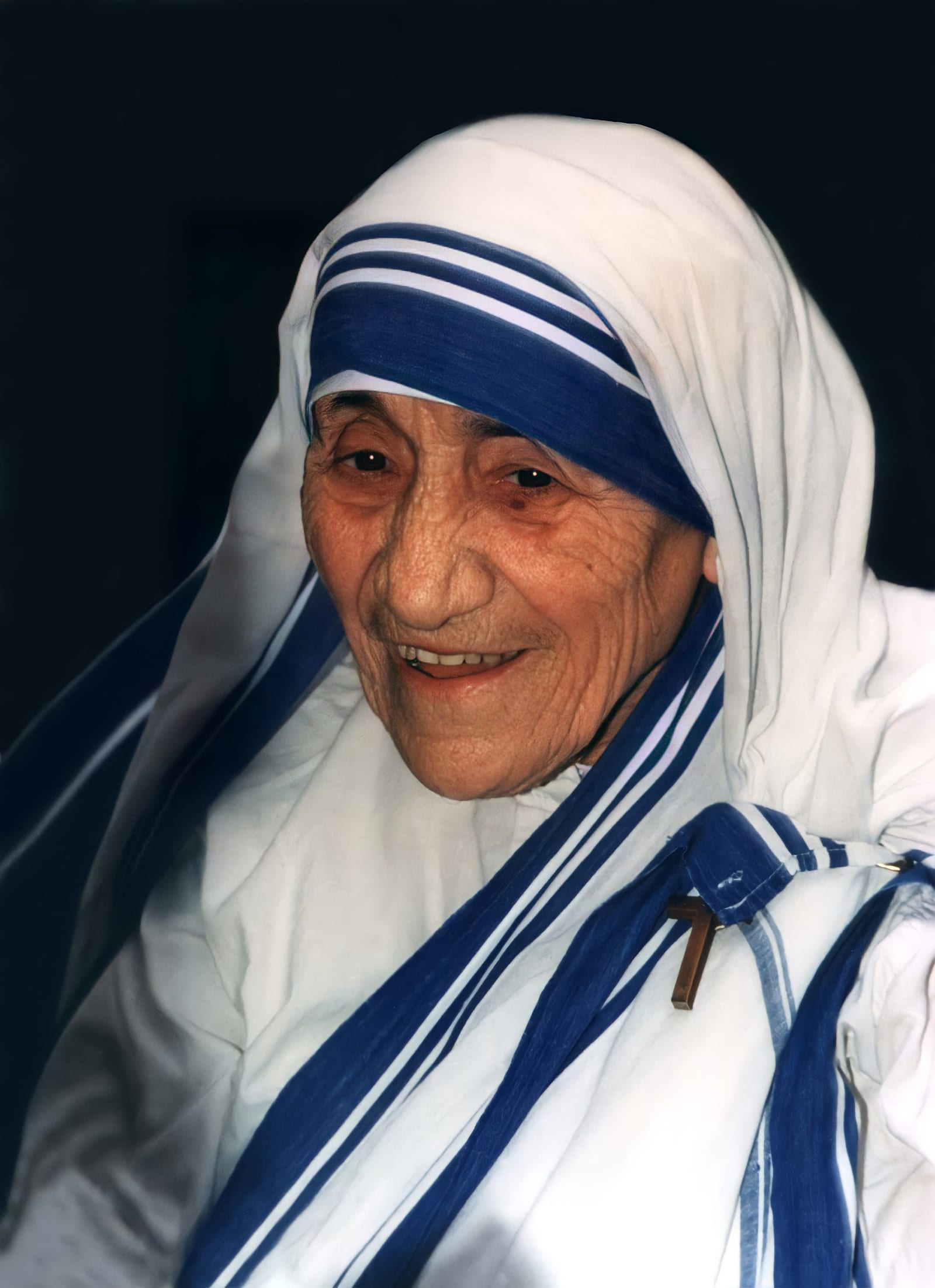
Anjezë Gonxhe Bojaxhiu — Agnes — was born to ethnically Albanian Catholic parents in Skopje. Her father, a successful merchant, died when she was eight, possibly poisoned for his nationalist sympathies. The family fell into poverty.
At eighteen, drawn to mission work in India, she left home to join the Sisters of Loreto in Ireland and was sent to Calcutta in 1929. She taught at St. Mary's School for over a decade, became its headmistress, and took final vows as Sister Teresa.
On September 10, 1946, riding the train to Darjeeling for a retreat, she received what she would always call her 'call within a call': to leave the cloister, take Indian citizenship, and 'satiate the thirst of Jesus on the cross for love and souls' by working with the poorest of the poor. Permission took two years; she went out alone into the slums of Calcutta in 1948 in a white sari with a blue border. In 1950 the Missionaries of Charity were formally founded.
By her death in 1997 the order numbered nearly 4,000 sisters in 123 countries — running homes for the dying, leper colonies, soup kitchens, orphanages, and AIDS hospices. She received the Nobel Peace Prize in 1979 — accepting it 'in the name of the poor' and asking that the customary banquet be cancelled and the funds given to the poor. Canonised by Pope Francis in 2016. Her posthumously published letters revealed a fifty-year 'dark night of the soul' she bore in silence — what the Church reads as her participation in the very desolation of Christ.