
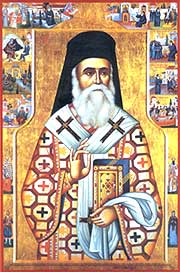
Anastasios Kefalas was born to a poor Thracian Greek family at Selybria on the Marmara coast (now in European Turkey). After difficult years at Constantinople and Chios — where he was tonsured monk under the name Nektarios in 1876 — he was sent at the expense of the Patriarchate of Alexandria to study at the University of Athens. He was ordained priest at Alexandria in 1886 and rose rapidly through the Alexandrian patriarchate, being consecrated Metropolitan of Pentapolis (a titular Libyan see used for senior Alexandrian-Patriarchate offices) in 1889 at forty-three.
He was identified as the next Patriarch of Alexandria — the senior Greek Orthodox patriarchate of Africa. Then, in mid-1890, in circumstances that have never been fully clarified but appear to have involved political-curial intrigue within the Alexandrian patriarchate (he was apparently too independent of the Greek-Alexandrian merchant lobby), he was abruptly stripped of his position, removed from Egypt, and left destitute in Athens with no income or assignment. He was forced to live in poverty in Athens for nearly five years, supporting himself by parish-priest-pension scraps.
From 1894 to 1908 he served as director of the Rizareios Ecclesiastical School in Athens — the principal Greek theological seminary of pre-war Greece. He wrote during this period a substantial corpus of dogmatic theology, ascetical literature, and Marian devotional verse — over 30 published volumes, the largest single corpus of modern Greek Orthodox theology. In 1904 he founded the small Holy Trinity Convent on the island of Aegina (the small Saronic Gulf island near Athens) for ten women religious; he retired there in 1908 and served as the convent's chaplain and spiritual director for the last twelve years of his life.
He died at the Aretaieio Hospital in Athens on November 8, 1920 of cancer. Reports of healings at his tomb at Aegina began immediately. By the 1950s he had become the most popular Greek Orthodox saint of the 20th century; canonization by the Ecumenical Patriarchate in 1961 made formal what had long been a continuous popular cult. He is invoked particularly by cancer patients across the Orthodox world, with a substantial dossier of attested cures.