
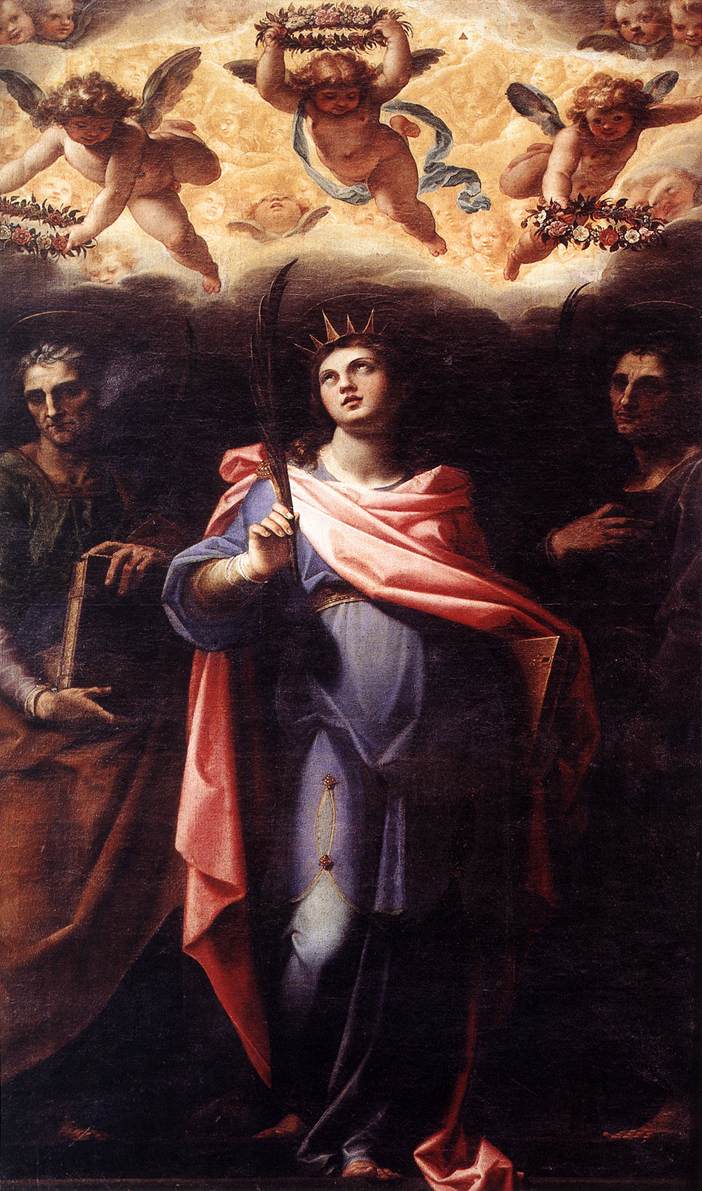
All that is known of Nereus and Achilleus for certain is what Pope Damasus carved over their grave at the end of the fourth century: that they were soldiers, bound to a tyrant's cruel orders, who at their conversion threw away their shields and their blood-stained weapons and went gladly to their deaths. Their tomb was in the catacomb of Domitilla on the Via Ardeatina, and the old Roman lists of the fifth century name them there. A basilica was raised over the grave in the last years of the fourth century, fell into ruin after the ninth, and was found again in 1874 with a fragment of Damasus's inscription in it and a marble pillar of the altar canopy on which the beheading of Achilleus is carved, his name cut above it.
Everything else, the Acts that make them eunuchs in the household of Flavia Domitilla, baptised by St. Peter, exiled with her to Ponza and beheaded at Terracina, was written centuries later and, in the words of the Catholic Encyclopedia, is legendary even to a romantic degree and of no historical value for their life and death. The site gives the epitaph and the pillar, which are evidence, and the legend as a legend.
Their relics were carried inside the walls to the church that bears their names by the Baths of Caracalla, where Cardinal Baronius, restoring it in 1597 as his titular church, had the story of the martyrs painted on its walls. They are venerated there under the high altar with St. Domitilla, and their feast on 12 May is kept by the whole Latin Church as an optional memorial.