
MIRACULOUS MIRACLES™

Saint — Nicephorus I of Constantinople

St. Nicephorus I of Constantinople
c. 758 AD, Constantinople (Byzantine imperial-bureaucratic family) — June 5, 828 AD, Monastery of St. Theodore at Chrysopolis, Byzantine Bithynia
Patriarch of Constantinople 806–815; iconodule confessor
Hagia Sophia, Constantinople — his cathedral see; the eastern-Catholic and Orthodox shrine of the Ecumenical Patriarchate, Turkey
Feast
June 2 (Orthodox); March 13 (Catholic; transferred for translation)
Canonized
Pre-congregation; venerated jointly in the Catholic and Orthodox calendars as an iconodule confessor
Life

Nicephorus was the son of an imperial Byzantine secretary who had been deposed, beaten, and exiled under the first iconoclast emperor Constantine V (754–775) for refusing to subscribe to the iconoclast canons — placing the son in the first-generation iconodule-confessor tradition.

Despite this dangerous family background, his learning and political skills brought him to high imperial-bureaucratic office under the iconodule empress Irene (797–802), where he played a role in the iconodule consolidation that produced the Second Council of Nicaea (787) under his eventual predecessor Tarasios.

Around 803 he withdrew from the imperial court and founded a private monastery on the Bosphorus. On Tarasios's death in 806, he was elected — over Theodore the Studite's monastic-party objection — Patriarch of Constantinople by Emperor Nikephoros I.

When the second iconoclast crisis broke out under the new emperor Leo V the Armenian (813), Nicephorus stood firm: refusing to remove the icons from Hagia Sophia, refusing to sign the new iconoclast formula, and confronting the emperor directly. In March 815, Leo V deposed and exiled him to the monastery of St. Theodore at Chrysopolis on the Asian side of the Bosphorus.

He spent thirteen years in monastic-imposed exile (815–828), composing his theological refutations of iconoclasm — the three Antirrhetici (Refutations) against the iconoclast claims, the Apology and the Greater and Lesser Refutations against the iconoclast Council of Hieria of 754. He died in exile on June 5, 828; his relics were translated to Hagia Sophia on March 13, 847 by Empress Theodora and her iconodule restoration — the date kept in the Latin Catholic calendar.

Miracles & Phenomena
  • The iconodule confessor theology

    Nicephorus's three Antirrhetici (Refutations) and the Apology, composed in monastic exile, constitute the eastern-Catholic theological refutation of iconoclasm — the philosophically and patristically rigorous demonstration that the Incarnation requires icon-veneration, and that iconoclasm is implicit Christological heresy denying the reality of the Word-made-flesh. The texts shaped the restored iconodule theology of the Second Council of Constantinople (Council of 879) and remain authoritative in eastern-Catholic and Orthodox theology to this day.

  • The translation of 847 — feast of Orthodoxy preparation

    The translation of Nicephorus's relics to Hagia Sophia on March 13, 847 — five years after the restoration of icons under Empress Theodora at the Council of Constantinople in March 843 (the 'Triumph of Orthodoxy' / Feast of Orthodoxy) — institutionally confirmed Nicephorus as the iconodule confessor of the second iconoclast period, alongside Theodore the Studite and Methodius I.

Relics
  • Body
    Relics of St. Nicephorus I
    Hagia Sophia, Constantinople (in continuous Orthodox liturgical use 537–1453; converted to mosque 1453–1934; museum 1934–2020; mosque since 2020). Major fragmentary relics survive in the Ecumenical Patriarchate cathedral of St. George at the Phanar, Istanbul.

    His relics, translated to Hagia Sophia in 847, were among the principal relics of the great cathedral throughout the Byzantine and Orthodox period. After the 1453 Ottoman conquest, fragmentary relics were preserved by the Ecumenical Patriarchate and are venerated today at the cathedral of St. George at the Phanar in Istanbul.

Iconography
  • Nicephorus refusing the iconoclast formula

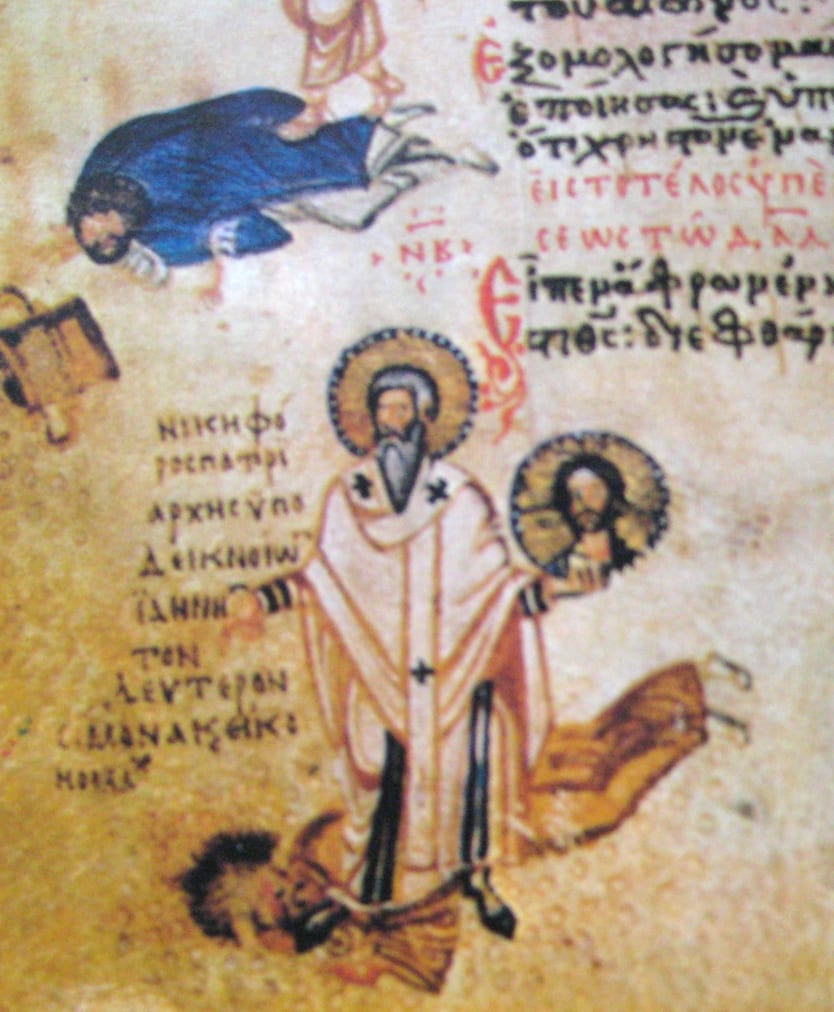
    The early-9th-century Patriarch of Constantinople in patriarchal vestments before the iconoclast emperor Leo V the Armenian (March 815) refusing to sign the iconoclast formula, the icon of the Pantokrator held openly in his hands — the iconography of eastern-Catholic iconodule confessor tradition.

Patronages
Catholic and Orthodox iconodule confessor traditionThe Greek/Byzantine Catholic and Orthodox episcopal-confessor tradition