
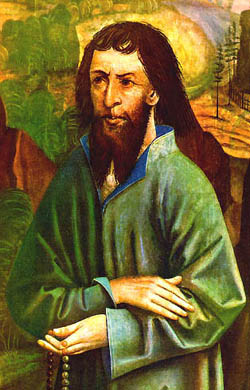
Niklaus von Flüe — universally called 'Brother Klaus' (Bruder Klaus) — was a prosperous Swiss peasant-farmer, member of the Obwalden cantonal parliament, soldier in the wars against the Habsburgs and the Toggenburg, and a respected magistrate of his community. He married Dorothea Wyss in 1446; they had ten children. He served as cantonal judge and was offered (and declined) the office of Landammann.
In 1467, at fifty, with the agreement of his wife and after the youngest of their ten children had been weaned, he left the family farm to embrace the life of a hermit. After a failed attempt at journeying into German exile (he turned back at the Rhine), he settled in a small hermitage at Ranft — about half an hour's walk from his own farmhouse, on the edge of his own fields, where he could be visited by his family. There he lived for twenty years until his death.
The most famous phenomenon of his life is his eucharistic fast: from 1467 until his death twenty years later he is reported to have lived without any nourishment except for the consecrated Host at periodic Mass — a phenomenon examined skeptically by ecclesiastical and civil authorities of the time and accepted by all of them as genuine. He became the spiritual oracle of all the Swiss cantons: visitors and ambassadors from all over the Confederation came to consult him. In December 1481, when the Swiss Confederation was on the verge of civil war between the urban and the rural cantons at the Diet of Stans, the parish priest of Stans Heimo Amgrund travelled to Ranft and returned with Brother Klaus's recommendations; the Diet's compromise — the Stanser Verkommnis — held the Confederation together. Switzerland regards him as the spiritual father of Swiss neutrality. He died at Ranft on March 21, 1487, the day of his seventieth birthday. Canonized by Pius XII in 1947.