
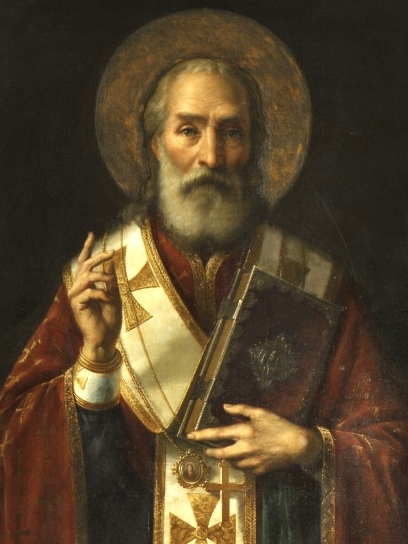
Nicholas was born to wealthy Christian parents at Patara in Lycia (southern Turkey). Orphaned young, he inherited a great fortune which he gave away in secret charity. The most famous incident: hearing of a poor father who was about to be forced to send his three daughters into prostitution because he could not provide dowries, Nicholas threw three bags of gold through the window on three successive nights — the historical origin of the Christmas stocking and of his patronage of pawnbrokers (whose three-gold-ball sign is a remembrance of this).
He was elected bishop of Myra. He attended the Council of Nicaea in 325 — by a popular tradition he struck Arius across the face for blasphemy. He continued his secret almsgiving as bishop; the people of Myra grew to revere him as 'the wonderworker.' He raised three murdered children pickled in a brine-tub by a wicked innkeeper, gave the Gospels to sailors who later survived a storm by his intercession, and on innumerable occasions appeared in dreams to deliver the imprisoned and the desperate.
His relics were translated from Myra to Bari, Italy, in 1087 by Italian sailors. The Basilica of San Nicola has been one of the principal Catholic shrines of southern Europe ever since; his image, traditions, and feast day spread across both the East (where he is the most venerated saint after the Theotokos) and the West.
Through Dutch immigrants who carried his cult to New Amsterdam (later New York), 'Sinterklaas' became 'Santa Claus' — by the 19th-century writings of Washington Irving, Clement Clarke Moore, and Thomas Nast he was transformed into the modern Christmas figure. The historical Nicholas of Myra and the popular Santa Claus are the same man, four-and-a-half centuries on.