
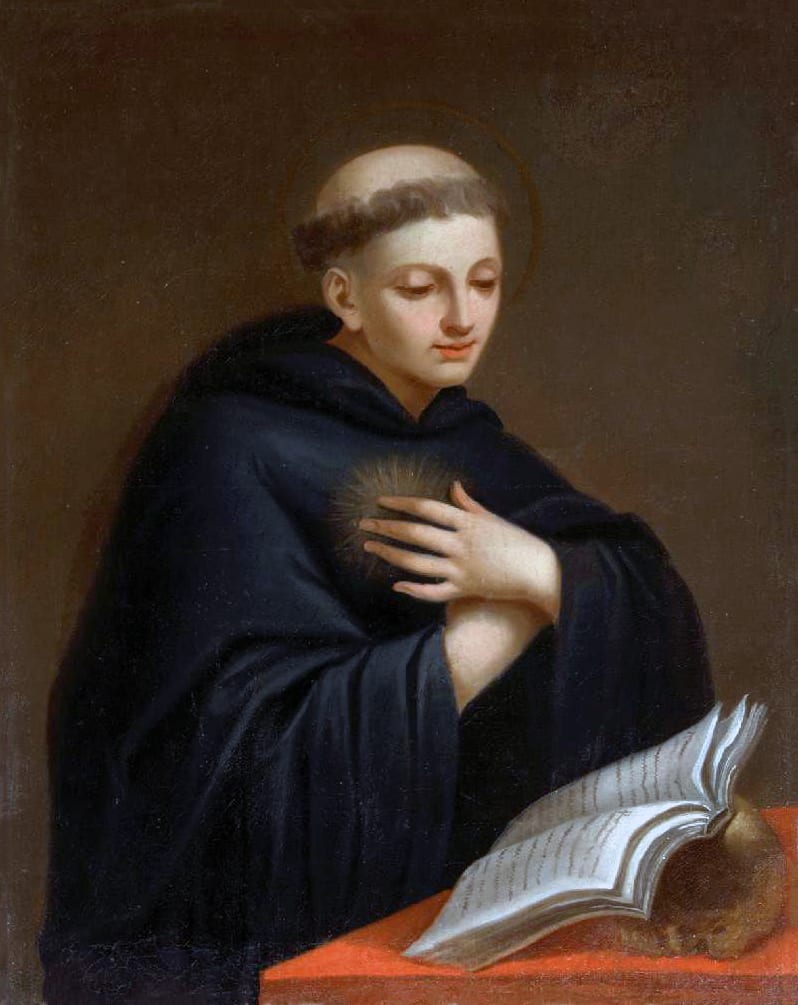
Nicholas was born at Sant'Angelo in Pontano in the Marche of Ancona to a poor family who had prayed at the shrine of St. Nicholas of Bari for the child's conception — hence his name. He entered the new Order of Hermits of St. Augustine (the Augustinian Hermits, OSA) around 1260 — the order formed by the Grand Union of 1256, which Pope Alexander IV had created by amalgamating several Italian hermit congregations under the Rule of St. Augustine.
From 1275 he was assigned to the community at Tolentino, where he remained for the last thirty years of his life. He was known as a brilliant preacher (his sermons drew crowds from across the Marche), as a tireless visitor of the sick and the dying, and as a man of severe penance: he ate only bread, water, and vegetables, slept on bare boards, and is the first major saint in the Latin tradition to have lived deliberately as a vegetarian for religious reasons.
His central devotion was to the souls in purgatory. After a vision in which a recently deceased friar appeared to him to ask for Masses for the relief of souls suffering in purgatory, Nicholas began the celebration of seven consecutive days of Masses on behalf of the dead — the seed of the modern devotion of the Augustinian 'Souls in Purgatory' rosary and the 'Bread of St. Nicholas' (small loaves blessed and given to the sick or used for the dying). He died at Tolentino on September 10, 1305, and was canonized in 1446 — the first canonized Augustinian Hermit.