
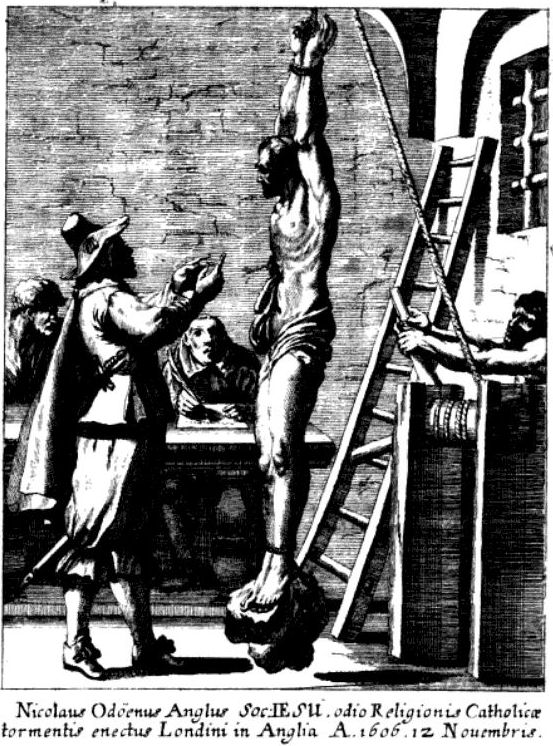
Nicholas Owen was a small, lame Oxford joiner — a Catholic from a recusant family that gave the Church three Catholic priests of his generation. He was received as a lay servant by the Jesuit superior Henry Garnet in 1577, made his perpetual vows as a Jesuit lay brother in 1580 (the brother form of religious life was the standard for skilled tradesmen who entered the Society of Jesus), and then served the English mission for some twenty-six years.
His specialized work was the construction of priest-holes — clandestine hiding-places for Catholic priests in the great recusant houses of England. He travelled from house to house, working at night and in secret, designing and building hidden compartments that survived the most thorough Elizabethan and Jacobean priest-hunter searches: chimney-shafts that opened into hidden cells, tiles that pivoted to reveal trapdoors, double walls with concealed sliding panels. The priest-holes he built at Harvington Hall (Worcestershire), Sawston Hall (Cambridgeshire), Hindlip Hall (where he was finally caught), Coughton Court, and dozens of other houses are masterpieces of clandestine engineering. Several have only been rediscovered in modern times.
Captured during the manhunt that followed the Gunpowder Plot of November 1605 (at Hindlip Hall, where after eight days hidden in a priest-hole he and Edward Oldcorne emerged when their food ran out), he was taken to the Tower of London. Suffering from a hernia that the rack would tear open if used standardly, he was suspended by iron gauntlets from a wall — a deliberately tortuous method designed to give the appearance of his having spilled his own intestines as if by suicide. He died on March 2, 1606, having never revealed the names of any of his fellow Catholics or the location of any of his hiding-places. The Tower constable Sir William Waad publicly announced he had killed himself; modern forensic investigation has confirmed the medical impossibility of the official story. Canonized 1970.