
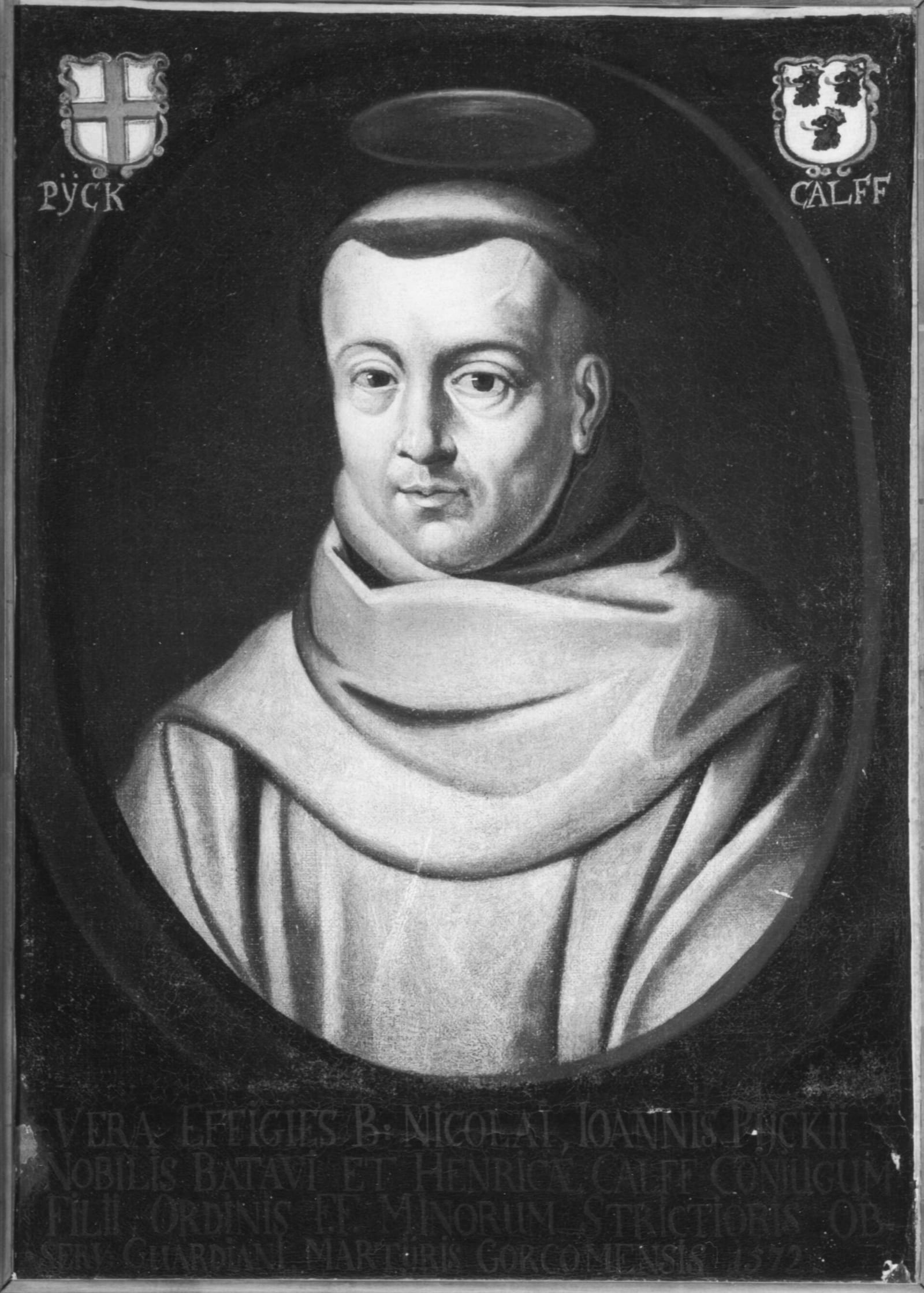
Nicholas Pieck was born at Gorkum in Holland in 1534, entered the Friars Minor, studied at Louvain, and returned to his native town as guardian of its Franciscan friary — a gentle, learned superior in a land splitting apart along the fracture lines of the Reformation. When the militant Calvinist sea-raiders called the Watergeuzen took Gorkum in June 1572, Pieck and his friars were seized with the town's secular clergy.
For days the captives were tortured and mocked, then shipped to Brielle, the raiders' stronghold. There the count Lumey de la Marck offered them their lives on two conditions: deny the Real Presence of Christ in the Eucharist, and deny the primacy of the pope. Letters from William of Orange ordering the priests released were ignored. Pieck, as guardian, answered for his brethren and refused both denials; witnesses record that he encouraged each of his companions in turn, telling them heaven was worth more than life.
In the night of July 9, 1572, the nineteen — eleven Franciscans, a Dominican, two Norbertines, an Augustinian canon, and four secular priests, among them the aged and the infirm — were hanged from the beams of a turf-shed in the ruined monastery of St. Elizabeth outside Brielle. Nicholas Pieck was hanged first. The bodies were mutilated and cast into ditches; recovered later, the relics rest today in the Franciscan church at Brussels, and the field of the shed is the Netherlands' national shrine of the martyrs.
Beatified in 1675 and canonized by Pius IX in 1867, the Martyrs of Gorkum became for Dutch Catholics the seal of survival through two centuries of suppression — witnesses, in the two truths they would not surrender, to the Eucharist and the unity of the Church.