
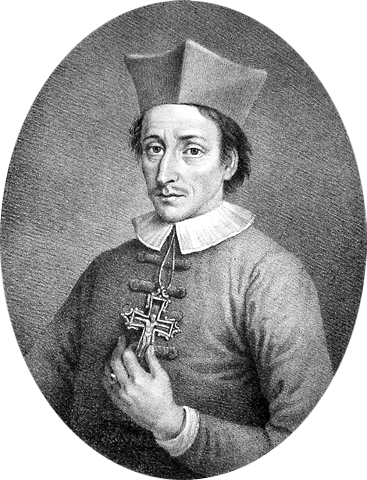
Niels Stensen (Latinized Nicholas Steno, Danish Niels Stensen) was born on January 11, 1638 at Copenhagen to a Lutheran family. Educated at the University of Copenhagen and at Leiden and Paris, Steno became the leading anatomist and geologist of the Grand Siècle.
Steno's scientific contributions:
1. The Steno's Duct (parotid gland duct, discovered 1660) — one of the principal anatomical discoveries of the 17th century.
2. The Principles of Stratigraphy (established 1669 in the *De Solido intra Solidum Naturaliter Contento Dissertationis Prodromus*) — Steno's Three Laws of Stratigraphy (Law of Superposition, Law of Original Horizontality, Law of Lateral Continuity) — the scientific foundation of geology and paleontology. Steno is considered the father of stratigraphy and modern geology.
In 1667, at the Medici court of Grand Duke Ferdinando II in Florence, Steno converted from Lutheranism to Catholicism. In 1675, Steno undertook the Catholic priestly ordination — abandoning his scientific career for the Catholic priestly ministry.
In 1677, Steno was consecrated Titular Bishop of Titiopolis and appointed Apostolic Vicar of the Nordic Missions — the Catholic bishop-in-exile ministry to the Scandinavian and northern German Catholic communities in the Lutheran territories.
For the 9 years (1677–1686), Steno undertook the systematic Catholic pastoral ministry across Hannover, Münster, Hamburg, and Schwerin — serving tiny scattered Catholic communities in the Lutheran territories under extreme personal poverty.
He died at Schwerin on November 25, 1686 at the age of 48.
Beatified October 23, 1988 by Pope St. John Paul II — the Vatican recognition of Steno as the model of the Catholic scientist-saint.