
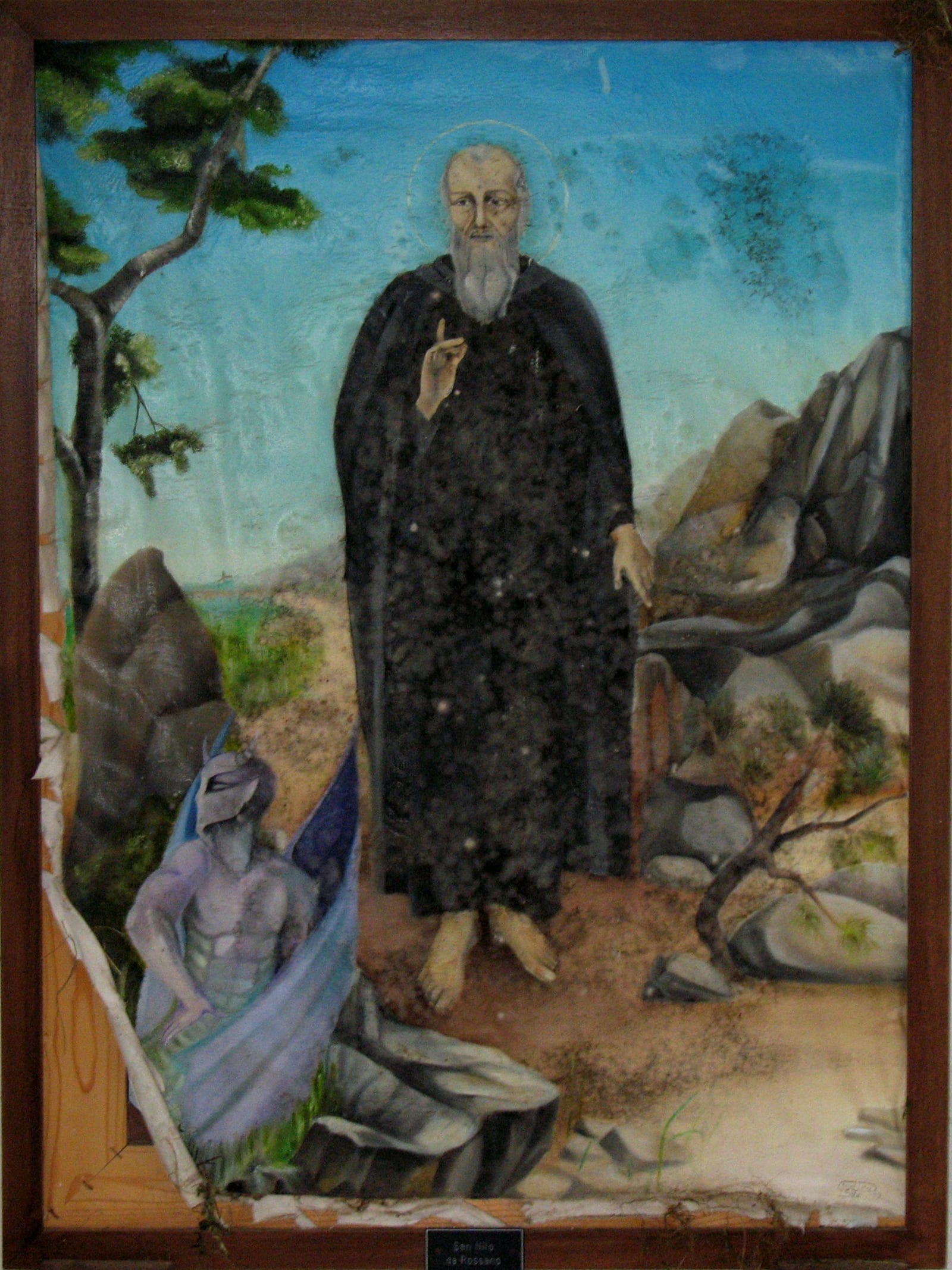
Nilus was born around 910 in Rossano, Calabria — the principal Greek-Italian (Magna Graecia) Catholic cultural centre of the southern Italian peninsula. The Italo-Greek Catholic tradition of Calabria, Apulia, and Sicily — preserving the Greek Byzantine liturgical rite under Roman papal jurisdiction — is the Catholic ecclesiastical heritage that Nilus would institutionally enshrine for the thousand years.
After a youthful marriage that ended with his wife's early death and the death of his infant daughter, Nilus entered monastic life around 940 at the Italo-Greek Catholic monastery of Saint Mercurius near Rossano. He became abbot, then withdrew to a hermit's cave-cell at Mount Mercurion in the mountains of Calabria.
Around 980, fleeing the accelerating Saracen raids on Calabria, Nilus and his disciples migrated north — first to the Abbey of Monte Cassino (where they were hospitably received by Abbot Aligernus and where Nilus spent years), then to the Greek monastic community at Valleluce.
In 1004, at the age of 94, Nilus arrived at Tusculum near Rome — where Count Gregory of Tusculum granted him the lands of a former Roman villa for the foundation of a new Italo-Greek Catholic monastery. Nilus died at Tusculum on December 26, 1004, before the monastery could be constructed — but his disciple St. Bartholomew of Grottaferrata completed the foundation in 1024.
The Abbazia di Santa Maria di Grottaferrata — founded on the site Nilus had selected — survives today as the only Italo-Greek Byzantine-rite Catholic monastery in continuous liturgical use since the medieval period, one of the principal Eastern Catholic monasteries of the Italian peninsula, celebrating the Byzantine Divine Liturgy in Greek and Old Church Slavonic to the present day.