
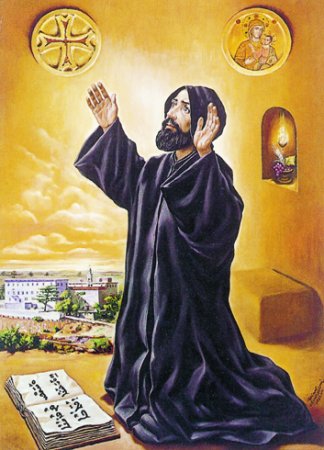
Yūsuf Jirjis Kassab was born to a Maronite peasant family in the small village of Hardine in the Mount Lebanon highlands — the heart of the historically Maronite Lebanese mountain country. He entered the Lebanese Maronite Order at the monastery of Saints Cyprian and Justina at Kfifan in 1828 at twenty, taking the religious name Nimatullah (Arabic: 'Grace of God'). He was ordained priest in 1835.
He served the Lebanese Maronite Order in the long generation of post-Ottoman-period Catholic reform of the Lebanese Maronite monastic tradition. He held successively the offices of professor of moral theology at the Kfifan seminary (for over twenty years — he trained an entire generation of Lebanese Maronite priests including, in the 1850s, the young monk Joseph Antoun Makhlouf, the future St. Sharbel — see his entry below), Assistant General of the Order three times, and acting Superior General twice. He was famous in the Order for a sustained combination of severe personal asceticism (continuous physical labour in the Kfifan monastery vegetable gardens, single daily meal, sleeping on the bare floor of his cell) with extraordinary teaching capacity in moral theology.
He died at the Kfifan monastery on December 14, 1858 at fifty. His body was buried at the monastery, where it has remained continuously. Beatified by John Paul II in 1998 and canonized in 2004 — the second Maronite Lebanese saint canonized by the Catholic Church in the modern era (after Rafqa Pietra Choboq Ar-Rayès in 2001 and just before St. Sharbel's parallel canonization process).