
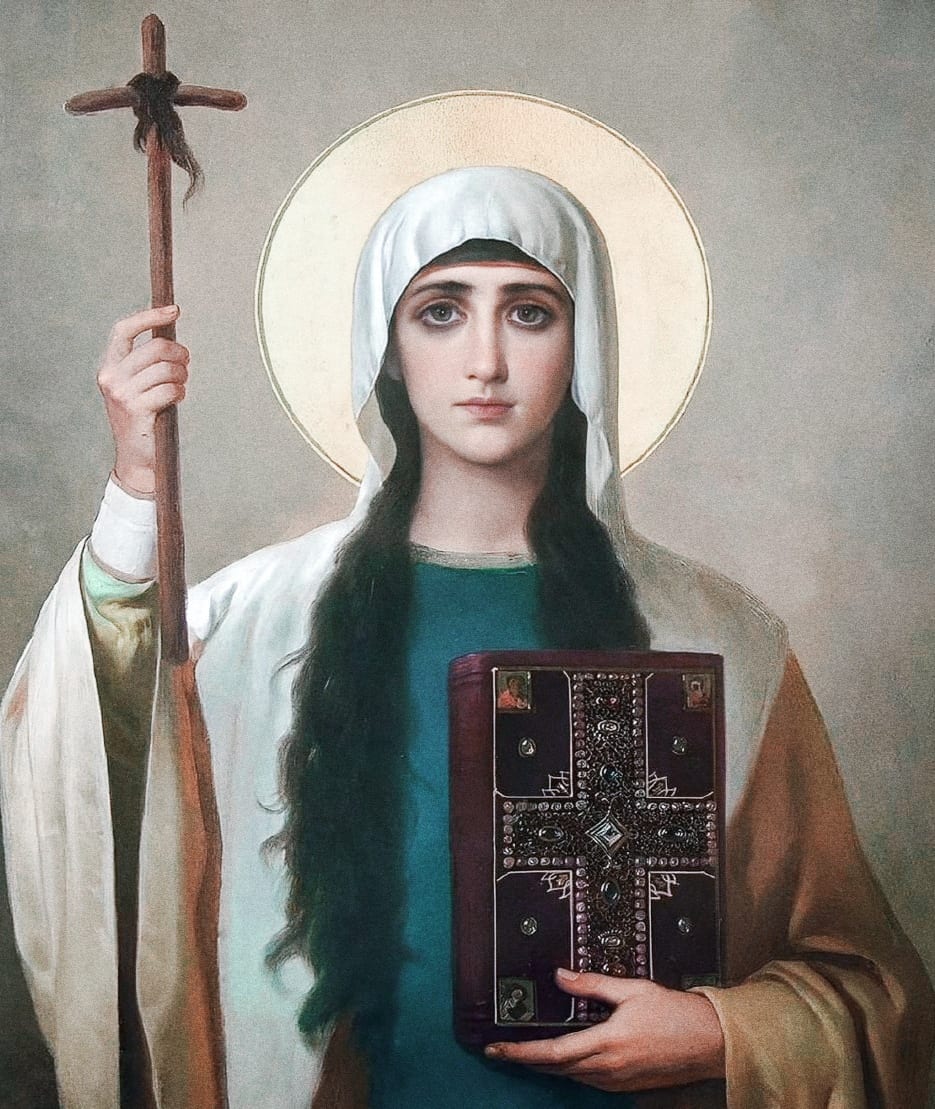
Nino (Georgian Ნინო, Greek Nona, Latin Nina) was — per the foundational Georgian tradition preserved in the Conversion of Kartli of the 9th century — a young Cappadocian Christian woman of the early 4th century, a relative of St. George of Lydda (see his entry already in the catalogue) and a foster-daughter of the Patriarch of Jerusalem.
Around 313 AD, sent by a vision of the Virgin Mary, Nino set out from Jerusalem to evangelize the Kingdom of Kartli (Iberia) — the great mountain kingdom east of the Black Sea, north of Armenia, in what is now Georgia. She entered the country with the small wooden cross — made of vine-wood and bound with her own hair (the celebrated 'Cross of Nino,' which remains the foundational Christian sacred-object of Georgia, preserved at Tbilisi).
She settled at Mtskheta (the ancient capital of Kartli), where she lived for many years as a small-house-cell anchoress in a noblewoman's garden. She converted the Queen Nana of Kartli through a miraculous healing, then the King Mirian III of Kartli (the foundational Christian king of Georgia) through a parallel intervention: in 326 AD, while hunting in the forest of Mukhrani, King Mirian was suddenly engulfed in darkness; he prayed to the gods of his ancestors without effect, then to the God of Nino, who restored the light. Mirian returned to Mtskheta a Christian and proclaimed Christianity the official religion of Kartli.
Nino retired in her last years to the small hermitage at Bodbe in the eastern province of Kakheti, where she died around 335 AD. Her tomb at Bodbe — preserved at the medieval Bodbe Monastery (Convent of St. Nino) on the easternmost edge of Georgia — remains the foundational Georgian national-religious pilgrimage site. Through her work the Kingdom of Kartli became the second Christian state in world history after Armenia (which was Christianized in 301 by Gregory the Illuminator) and the second-oldest continuously-Christian nation. Her cult — universally observed across Georgian, Byzantine, and broader Eastern traditions — has been at the centre of Georgian national identity for over 1,600 years.