
Notburga was born around 1265 to a peasant family at Rattenberg in the County of Tyrol (modern Austrian Tyrol on the Inn river). At the age of 18, she began serving as a household servant at the court of Count Henry of Rattenberg and Countess Ottilie of Rottenburg.
Notburga's household service is famous in the Tyrolean Catholic tradition for the pattern of her personal charity to the poor: she saved her meagre daily household provisions and distributed them to the poor at the castle gate — the classic medieval Catholic 'servant-saint' pattern.
After the death of Countess Ottilie, Count Henry remarried the harsh Countess Ottilie the Younger, who forbade Notburga's charitable distribution of household provisions to the poor. Notburga continued the secret charitable distribution, and when the Countess discovered the continuing charitable ministry, Notburga was dismissed from the household service.
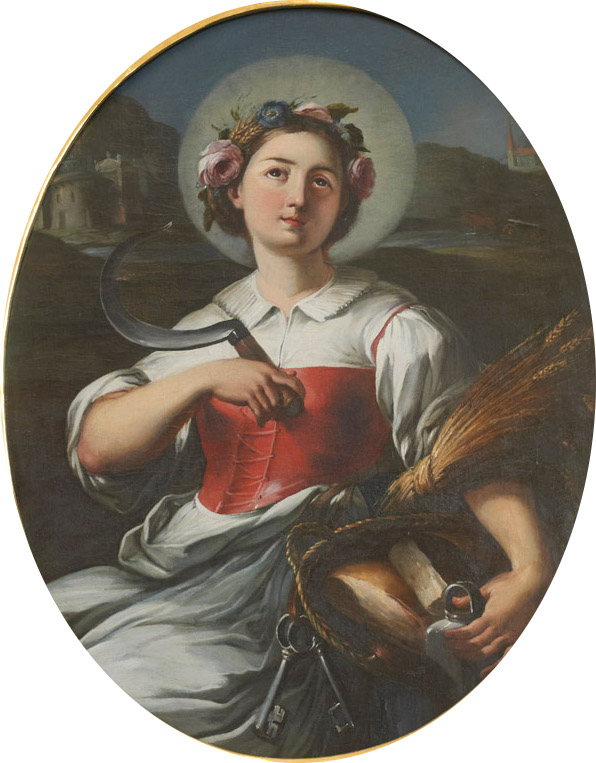
Notburga took new service at the farm of a peasant farmer at Eben am Achensee. Her most famous miraculous episode: on a Saturday evening, when the farmer demanded that Notburga continue the harvest-work into the evening (past the Vespers-signalled beginning of the Sunday-Sabbath rest), Notburga hung her harvest-sickle on a sunbeam — the sickle remaining suspended in the air as a visible miraculous witness to the sacredness of the Sabbath.
The 'Notburga sickle' — the famous iconographic attribute of the saint — establishes her patronage of agricultural workers and the Catholic-Tyrolean tradition of the Sabbath rest for the farm-workers.
Notburga died at Eben am Achensee on September 14, 1313. Her incorrupt body — preserved to the present day — rests at the Church of St. Notburga at Eben am Achensee, one of the principal Austrian Tyrolean Catholic pilgrim destinations.