
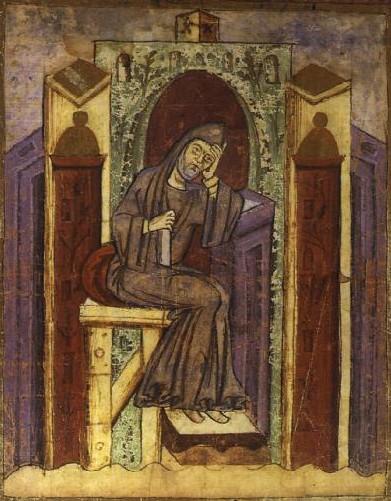
Notker — known by his Latin epithet Balbulus ('the Stammerer') for his lifelong speech impediment — was given as a child oblate to the Abbey of St. Gall in Switzerland and spent his entire life within the walls of that great Carolingian monastic centre.
He was the composer of approximately 40 Latin liturgical 'sequences' (sequentiae) — the new genre of Latin liturgical hymn-poetry composed to fit the extended melismatic 'jubilus' of the Alleluia at Mass. Notker's Liber Hymnorum (Book of Hymns) — completed around 884, dedicated to Liutward of Vercelli — is the first systematic collection of the sequence genre and the fountainhead of the entire medieval Latin sequence tradition that would produce the Victimae Paschali Laudes, Veni Sancte Spiritus, Lauda Sion, Stabat Mater, and Dies Irae.
His explanation of the origin of the sequence in his preface to the Liber Hymnorum — that he had heard from a French refugee monk how the practice of adding text to the Alleluia jubilus was practised in Jumièges, and that he had adapted and perfected the technique — is the primary source for the history of early Latin sequence-composition.
Notker also composed the Gesta Karoli Magni (Deeds of Charles the Great), the vivid and anecdotal life of Charlemagne for the Emperor Charles the Fat — among the principal sources for the Carolingian Charlemagne legend. He served as librarian and choirmaster of St. Gall and died there on April 6, 912.
His beatification by Pope Julius II in 1512 confirmed the immemorial Swiss-Benedictine cult; the famous Abbey of St. Gall library — preserving the manuscripts of Notker and his tradition — survives as an UNESCO World Heritage site.