
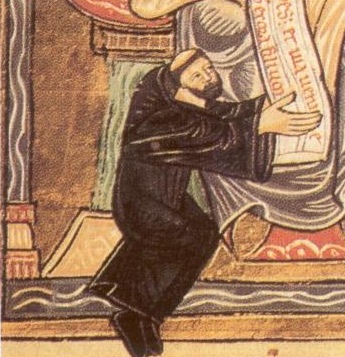
Odo was raised at the court of Count Fulk II of Anjou, then under Duke William I of Aquitaine. He entered the monastery of Baume-les-Messieurs under Berno around 909, and accompanied Berno to the new foundation of Cluny in Burgundy in 910 — the abbey founded by William of Aquitaine that would transform Western monasticism.
Odo succeeded Berno as abbot in 927 and governed Cluny for fifteen years. Under him the unique 'Cluniac' liberty — exemption from all local secular and episcopal jurisdiction, with the pope alone as superior — was secured and replicated at over forty other monasteries through his reform efforts.
He was repeatedly summoned to Rome to reform Italian monasteries and to mediate between the popes and the kings of Italy. The Cluniac movement he organized would, by the year 1100, include over a thousand monasteries spread across Latin Christendom and would be the principal force behind the Gregorian Reform and the elimination of clerical concubinage and simony from the Western Church.
He died at Tours in 942, praying at the tomb of St. Martin. The Cluny reform is one of the most consequential ecclesiastical movements of the entire medieval period.