
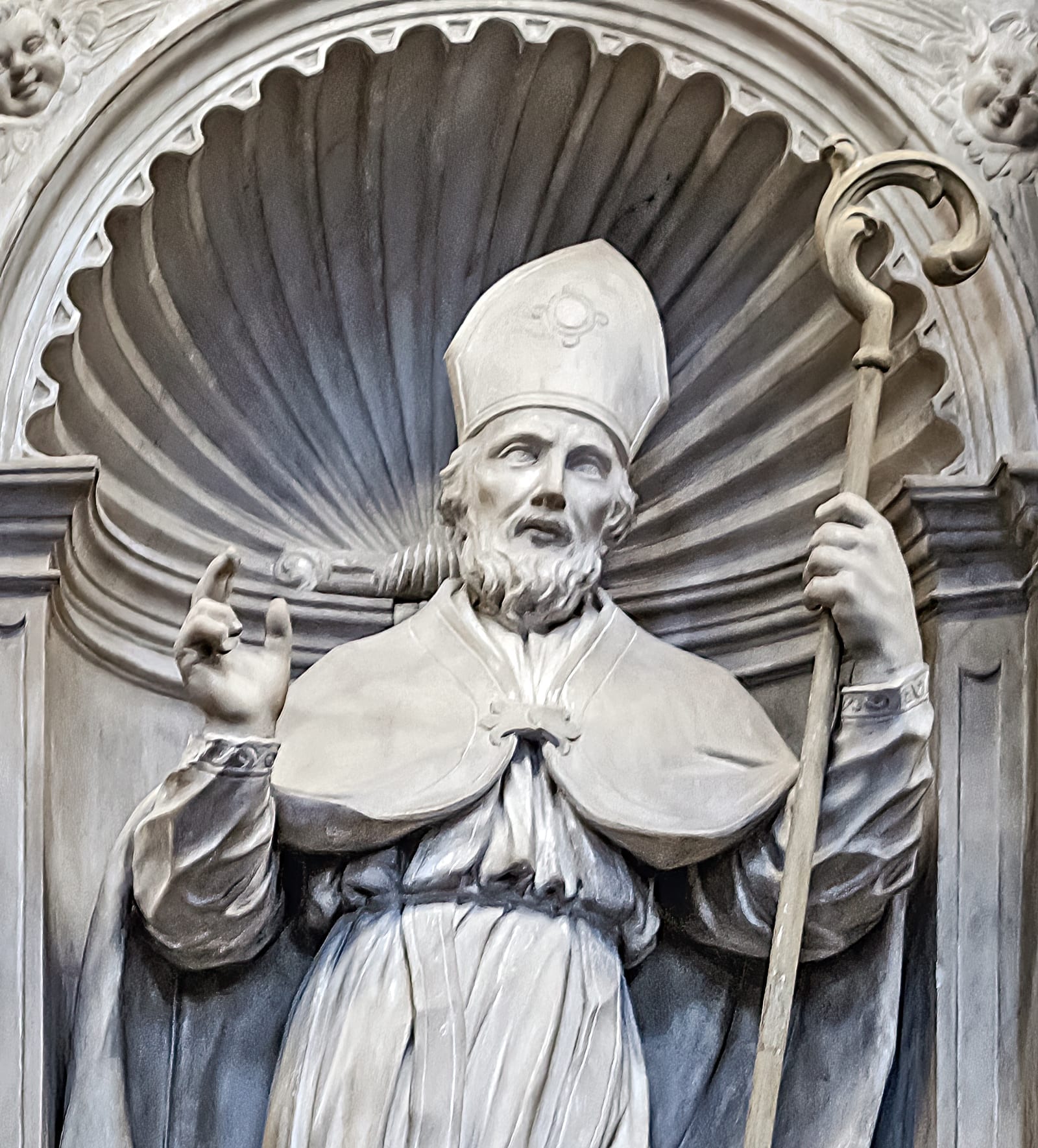
Olegarius (Catalan Oleguer, Spanish Olegario) was born in 1060 at Barcelona to a Catalan noble family during the period of Catholic Catalonian consolidation under the Counts of Barcelona.
Educated at the cathedral school of Barcelona, he became a canon of the cathedral at the young age of 15 — under the regime of canonical-canon-regular discipline inspired by the Augustinian Rule that the Reconquista-era Catalan Catholic cathedrals had adopted.
Around 1095, after the tragic death of his father, Olegarius undertook the pilgrimage to Rome and then entered the Augustinian Canons Regular community of Saint-Ruf at Avignon in Provence — one of the principal Augustinian-Canons-Regular reform communities of the late 11th and early 12th centuries.
He rose to be abbot of Saint-Ruf at Avignon, then abbot of Saint-Adrien at the Catalan abbey near Barcelona. In 1116 he was elected Bishop of Barcelona — taking up the governance of the principal Catalan Catholic see at the hour of the Reconquista-era institutional restoration of the southern Catalonian Catholic ecclesiastical hierarchy.
In 1118 — at the request of Count Raymond Berengar III of Barcelona and with the confirmation of Pope Gelasius II — Olegarius was appointed concurrently as Archbishop of Tarragona: the restoration of the ancient metropolitan see of Tarragona (founded by St. Paul himself, per the Catalan tradition, one of the principal Roman-era Catholic metropolitan sees of Hispania) after the four-and-a-half centuries of Moorish-Andalusian Muslim occupation (711–1118).
Olegarius's nineteen-year metropolitan tenure at Tarragona (1118–1137) — combined with the episcopal governance of Barcelona — was devoted to the systematic restoration of the Catholic ecclesiastical hierarchy across the Catalan-Pyrenean Reconquista frontier. He established the suffragan dioceses, rebuilt the ancient Tarragonan cathedral (on the site of the Roman Forum), organized the Catalan Catholic clerical reform.
He preached the Catalan participation in the First Crusade and the Catholic crusading-and-Reconquista campaigns, and negotiated the famous Catalan ecclesiastical-secular settlement of Reconquista-era Catalonia. He died at Barcelona on March 6, 1137.
His long-pending canonization was finally completed by Pope Clement X in 1675 — confirming the immemorial Catalan Catholic local cult that had been maintained since the 12th century.