
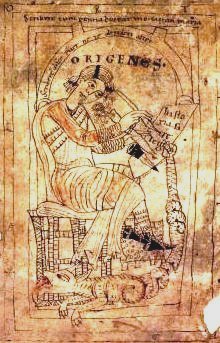
Origen (Greek Ōrigenēs, 'born of Horus' — his birth name) was born to a Christian family of Alexandria around 185 AD. His father Leonidas was martyred during the Severan persecution of 202 when Origen was 17; the young Origen famously wanted to follow his father to martyrdom but was prevented by his mother hiding his clothes. He took over leadership of the Catechetical School of Alexandria at 18, after the previous head Clement of Alexandria fled the persecution.
Origen's literary output is the largest of any pre-Constantinian Christian: Jerome estimated he wrote some 6,000 works (a figure modern scholars treat as exaggerated but indicative of an immense corpus). His Hexapla — a 50-volume parallel-column edition of the Old Testament in six versions (Hebrew, Hebrew in Greek transliteration, the Septuagint, and three other Greek translations) — was the first systematic biblical text-critical edition in Christian history and was the standard reference work of patristic-period biblical scholarship. His Commentaries (on most books of the Bible), Homilies (hundreds of preached expositions of Scripture), the systematic theological work On First Principles (Peri Archōn, c. 230 — the first Christian systematic theology), and his apologetic work Against Celsus (Contra Celsum, c. 248 — the foundational extended Christian apologetic response to a major pagan critic) together established the methodological and substantial framework of all subsequent patristic Christian scholarship.
His theological speculation in some areas — particularly on the pre-existence of souls, on apocatastasis (the possible final restoration of all rational creatures), and on subordinationist Trinitarian formulations — became controversial in the late 4th and 5th centuries, and several Origenist propositions were formally condemned at the Fifth Ecumenical Council of Constantinople II in 553. Origen himself, however, has never been condemned as a person, and his foundational status as a father of Christian biblical scholarship and systematic theology is universally acknowledged. He was tortured during the Decian persecution of 249–251 but survived; he died at Tyre around 253–254 of complications from the torture.