
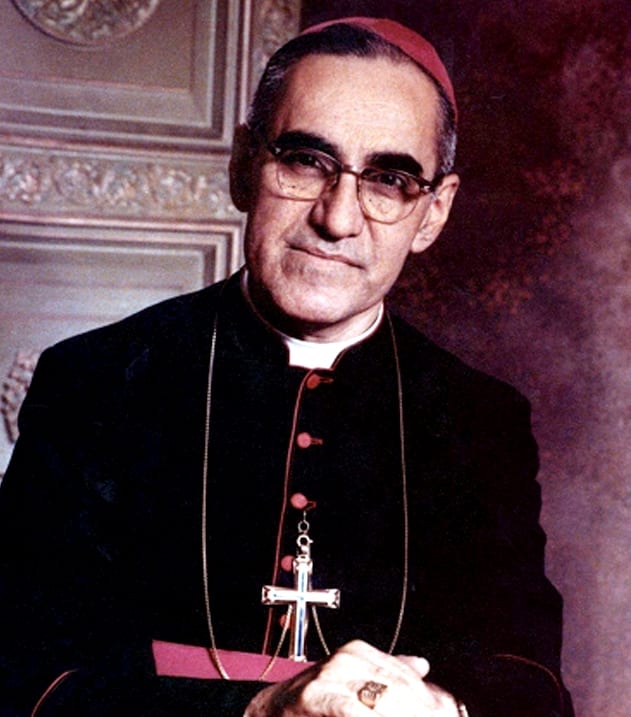
Óscar Arnulfo Romero y Galdámez was born in the small mountain town of Ciudad Barrios in eastern El Salvador, the second of seven children of a postmaster and his wife. He entered the seminary at fourteen, completed his studies at the Gregorian in Rome (1937–1943), was ordained there in 1942, and on returning to El Salvador served as a parish priest, seminary rector, and (by reputation a conservative) auxiliary bishop and then bishop of Santiago de María.
On February 22, 1977 he was named Archbishop of San Salvador — a choice welcomed by the conservative coffee oligarchy and the military government, suspicious to the progressive clergy. Three weeks later, on March 12, 1977, his close friend the Jesuit Fr. Rutilio Grande was assassinated by death squads on the road to Aguilares — along with an elderly peasant and a fifteen-year-old boy who had been travelling with him. Romero, looking on the bodies, was transformed. From that day his preaching became a relentless public denunciation of the death squads, the military government, the great landowners, and the United States military aid that sustained the regime.
For three years his Sunday homilies — broadcast on the diocesan radio station — were the principal source of independent information for the Salvadoran people. The deaths mounted: over 70,000 people would die in the civil war that followed, the majority murdered by government forces. On March 23, 1980 — in his last Sunday homily — Romero addressed soldiers directly: 'In the name of God, and in the name of this suffering people whose laments rise to heaven each day more tumultuously, I beseech you, I beg you, I command you — in the name of God: stop the repression!'
The next evening, March 24, 1980, while celebrating Mass at the chapel of the Divine Providence Hospital in San Salvador (where he lived in a small bungalow), a single rifle shot from a hidden gunman in a car at the chapel door killed him at the altar at the moment of the offertory. He was 62. The killer was a Salvadoran death-squad gunman acting on orders from the founder of the ARENA party, Roberto D'Aubuisson. Beatified by Francis as a martyr in 2015; canonised in 2018.