
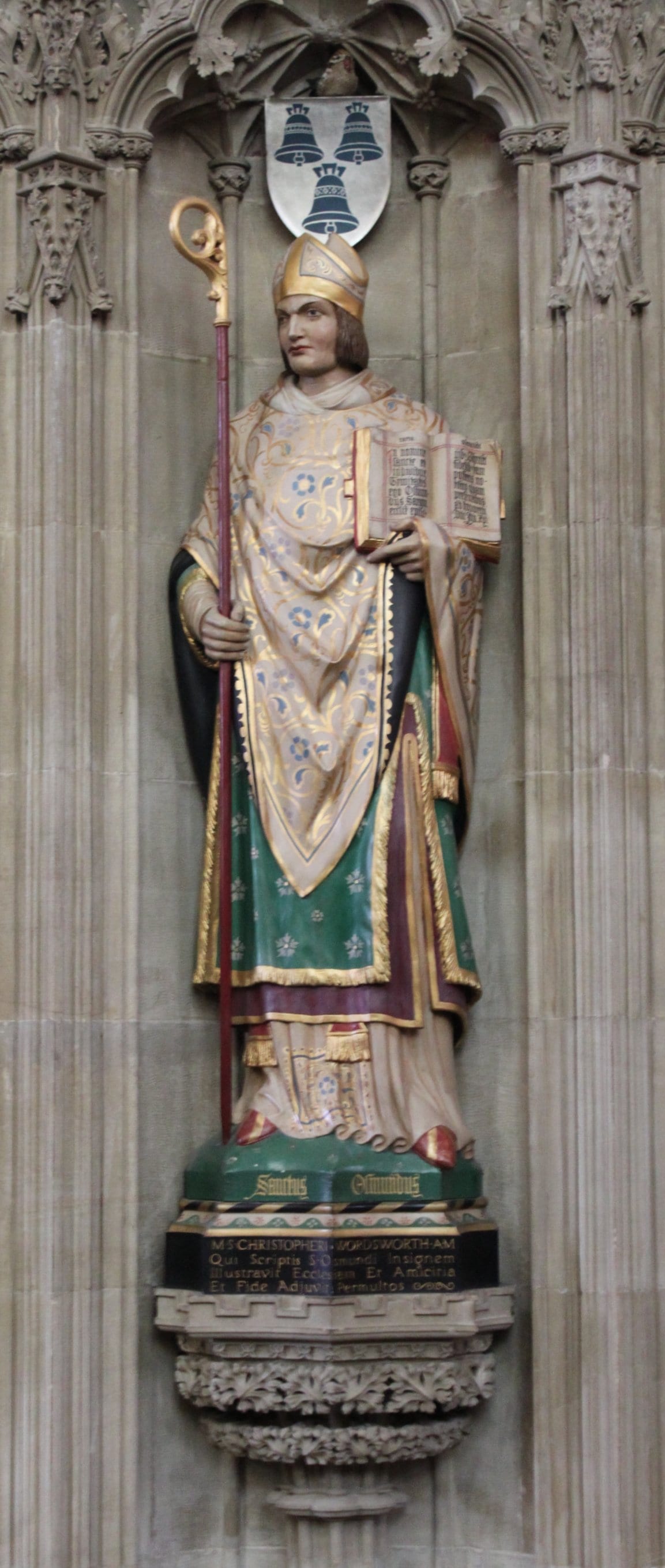
Osmund was born around 1030 in Sées, Normandy — son of Henry, Count of Sées, and nephew of Duke William the Conqueror. He accompanied his uncle William to England in 1066 at the Norman Conquest, serving in the royal Anglo-Norman administration as chancellor of England from 1070 to 1078.
In 1078 William the Conqueror appointed him Bishop of Salisbury — succeeding Herman as Bishop of the principal Wessex see that had been moved by Herman from the small village of Sherborne and Ramsbury to the fortified hilltop of Old Sarum (Old Salisbury, on the massive Iron-Age hillfort 2 miles north of modern Salisbury).
Osmund's twenty-one-year episcopate at Old Sarum (1078–1099) was devoted to the completion of the Norman cathedral at Old Sarum (consecrated April 5, 1092) and to the systematic Catholic liturgical reform of the Salisbury diocese.
Most consequentially, around 1085–1090 Osmund composed the Use of Sarum (Use of Salisbury) — the distinctive Catholic Latin liturgical rite that would become the principal medieval English rite. The Sarum Use — based on the Norman-Cluniac and the Continental Latin Roman liturgical tradition, adapted to the Catholic English pastoral and devotional context — spread from the Salisbury diocese to substantially all of medieval England, Wales, Ireland, and substantial parts of Scotland by the mid-12th century.
The Sarum Use remained the principal English Latin Catholic liturgical rite for the entire late-medieval period (approximately 1100 to 1549), producing the distinctive medieval English Catholic liturgical-and-musical tradition (the famous Sarum chant tradition, the Sarum vestments and processional traditions, the Sarum kalendar of English Catholic saints and feasts). When the English Reformation suppressed the Latin Catholic liturgy in 1549, the Sarum Use provided the principal source-material for the Anglican Book of Common Prayer (1549, 1552, 1559, 1662) — making the Osmund-Sarum tradition the direct liturgical ancestor of the entire Anglican Communion liturgical tradition.
Osmund also established the cathedral chapter of secular canons at Old Sarum on the Norman model (the so-called 'Osmundian constitution', the principal medieval English cathedral-chapter constitution) and established the cathedral library and scriptorium.
He died at Old Sarum on December 4, 1099. His principal relics were translated in 1226 to the new Salisbury Cathedral — the greatest of the English Early-English Gothic cathedrals (begun 1220, consecrated 1258 by Bishop St. Richard of Wych) — relocated from the dry hilltop of Old Sarum to the watered river-meadows of New Sarum (modern Salisbury). His canonization in 1457 by Pope Callixtus III was the last pre-Reformation canonization of an English saint.