
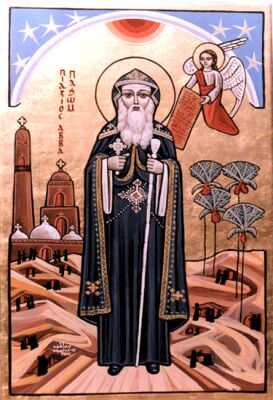
Pachomius was born to pagan parents in Upper Egypt. Conscripted into the Roman army as a young man, he was struck by the kindness of Christians who brought food to his unit; he vowed that if he survived his service, he would seek their God. On his release he was baptized, and joined a hermit named Palaemon for seven years of formation in the desert.
An angel told him to gather his fellow ascetics into a single common life. Pachomius founded his first monastery at Tabennisi in 318 — the first 'cenobium,' the prototype of organized communal monasticism. By his death in 348 he had founded nine monasteries for men and two for women, with some three thousand monks under a single Rule.
His Rule — the Rule of Pachomius — circulated across the Mediterranean. St. Jerome translated it into Latin in the late 4th century. St. Basil drew on it for his rule for Greek monasticism, and St. Benedict for his great Latin Rule in the 6th century. Through them, all subsequent Western monasticism — Cluny, Cîteaux, Camaldoli, the Carthusians, the Trappists — descends from the cenobium of Tabennisi.