
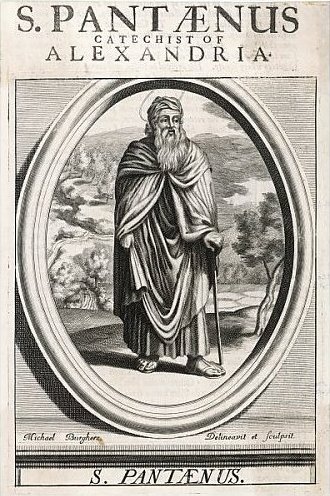
Pantaenus was a Sicilian Stoic philosopher of the mid-2nd century who converted to Christianity (probably at Alexandria) and became the founder — or at least the first identifiable head — of the celebrated Catechetical School of Alexandria around AD 180. The school — the first formal Catholic theological institution in the history of the Church — became the most important centre of early Christian theological scholarship, producing Clement of Alexandria (Pantaenus's immediate successor and student), Origen of Alexandria (Clement's student), and the entire foundational Alexandrian theological tradition.
Around AD 185 Pantaenus undertook the celebrated missionary journey to India — the first attested formal Catholic missionary effort to the Indian subcontinent. The mission is recorded by Eusebius (Church History 5.10): Pantaenus 'was sent to India by the Indian Christians themselves to preach to them' and 'found there the Gospel of Matthew in Hebrew' (a text identified by tradition with the so-called Hebrew Matthew — possibly the Aramaic-Matthean tradition mentioned by Papias). Whether 'India' in Eusebius's sense refers to the actual Indian subcontinent (south Asian Christian tradition holds that Pantaenus visited the Saint Thomas Christians of Malabar, established by the Apostle Thomas — see Thomas the Apostle in the 1st-c. catalogue) or to a closer Arabia Felix/Sabaean territory is debated.
He returned to Alexandria and continued teaching at the catechetical school until his death around AD 200. Through Clement and Origen the Alexandrian theological tradition he had founded would dominate Christian theology for the next two and a half centuries.