
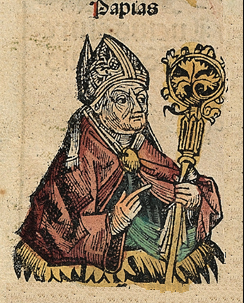
Papias was Bishop of Hierapolis — the great Phrygian city of the Lycus Valley near Colossae and Laodicea — in the early-to-mid 2nd century. Irenaeus, writing around AD 180, identifies him as 'a hearer of John' (the apostle), 'a companion of Polycarp,' and 'an ancient man.' Papias composed around AD 110–130 a five-book work called Exposition of the Sayings of the Lord (Logiōn Kyriakōn Exegesis), in which — explicitly preferring direct living oral testimony from those who had known the apostles to written texts — he gathered the oral traditions of the apostolic generation as they had been transmitted to him by 'the elders' who had been the apostles' disciples.
The Exposition itself is lost. Several substantial fragments survive in quotation by Eusebius (4th c.) and others. These fragments contain Papias's foundational testimonies about the composition of the Gospels: his statement that Mark was the interpreter of Peter and 'wrote down accurately, though not in order, what the Lord had said and done' (the foundational external attestation of the Petrine origin of Mark's Gospel), and his statement that Matthew 'compiled the sayings of the Lord in the Hebrew tongue, and everyone translated them as best they could' (the foundational external attestation of the Aramaic-Matthean tradition behind the canonical Matthew).
Papias is therefore one of the most historically consequential 2nd-century figures: a substantial portion of modern New Testament historical-critical scholarship — both supportive and critical — has rotated around the question of what to make of his testimony about the composition of the four Gospels. His feast as bishop and presumed martyr is February 22.