
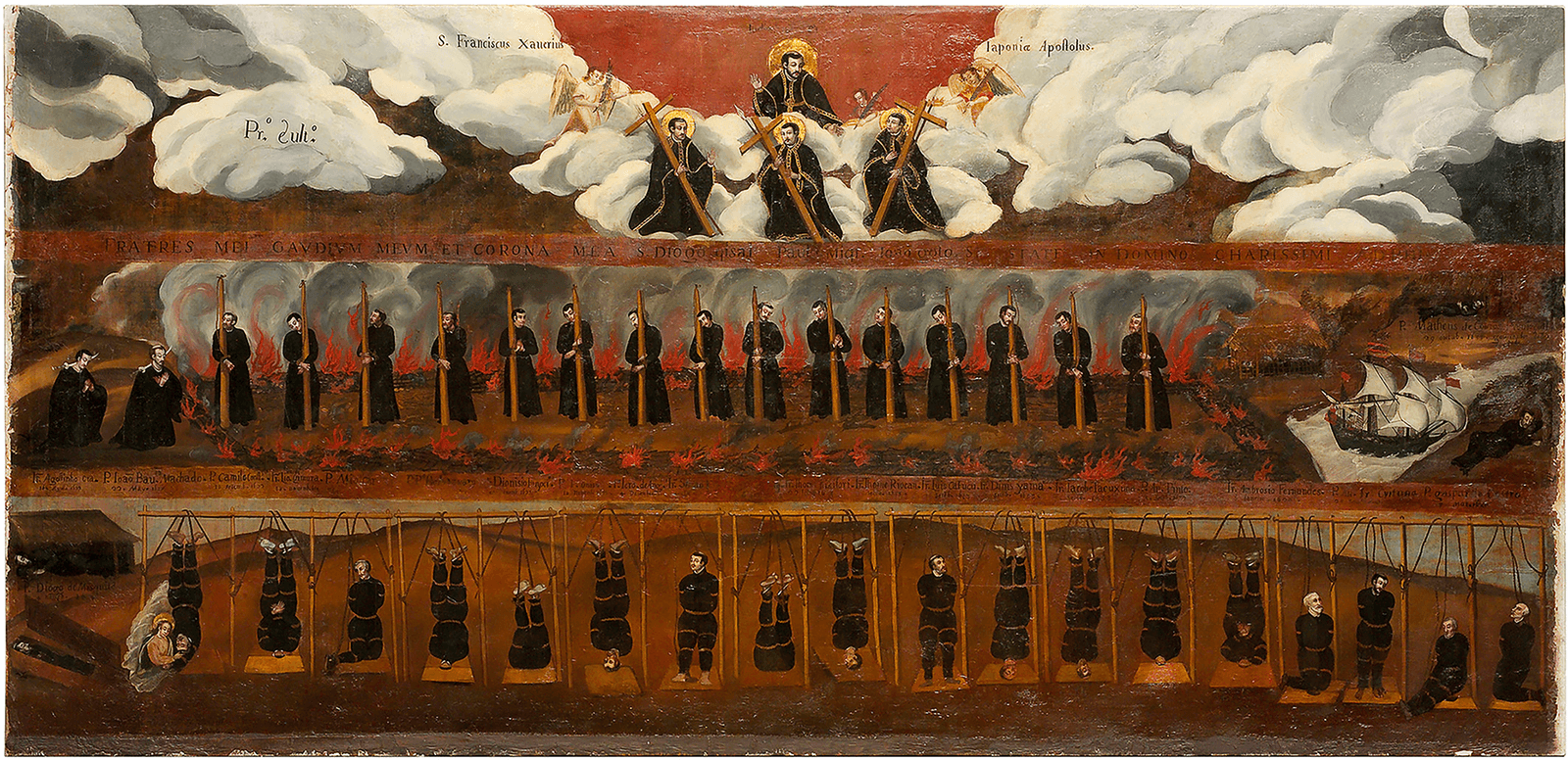
The twenty-six Christian martyrs crucified at Nishizaka Hill outside Nagasaki on February 5, 1597 were the first systematic Christian martyrdom in East Asian history. By 1596 the Japanese Christian community — planted in 1549 by St. Francis Xavier (see his entry in the 16th-c. catalogue) and grown over four decades to perhaps 300,000 Catholics — had become the focus of suspicion by the rising military dictator Toyotomi Hideyoshi, who had begun anti-Christian edicts in 1587.
The episode that triggered the executions was the catastrophic San Felipe affair: a wrecked Spanish galleon at Urado in October 1596, whose pilot — under interrogation — boastfully suggested that the Spanish missionaries were the advance guard of Spanish military conquest of Japan. Hideyoshi ordered the immediate arrest of twenty-four Christians in Osaka and Kyoto. They were marched on foot for nearly a month from Kyoto to Nagasaki — having their left ears cut off in Kyoto as a brand — and were joined by two additional volunteers along the way (making the final number twenty-six).
The twenty-six included six Spanish Franciscan friars led by Pedro Bautista (the Franciscan superior of Manila); three Japanese Jesuits including the celebrated 33-year-old preacher Paul Miki (a Japanese samurai-class convert and the most famous Catholic preacher of the Japanese mission); and seventeen Japanese laypeople — catechists, doctors, carpenters, the youngest a twelve-year-old altar boy named Louis Ibaraki. They were crucified at Nishizaka on February 5, 1597 — bound to crosses and pierced simultaneously by lances of crossing executioners. From his cross, Paul Miki preached his final sermon: he forgave the executioner Hideyoshi by name, declared his joy at dying for Christ, and prayed for the conversion of Japan.
Their deaths inaugurated the long Japanese persecution that would continue with brutal intensity for the next 250 years — 1597 to 1873 — producing an estimated 5,000–10,000 documented Christian martyrs, the largest sustained Catholic persecution-martyrology of the early modern period. The 'hidden Christians' (kakure kirishitan) of the Nagasaki region preserved the underground Catholic faith without priests for seven generations until the 1865 'Miracle of the Discovery' (when, after the partial 1858 Japanese opening, the French missionary Bernard Petitjean was approached at the new Nagasaki Catholic church by a delegation of Urakami villagers who quietly declared themselves the hidden descendants of the original Catholics, asking about the Pope, the Virgin Mary, and clerical celibacy as the three identifying marks of true Catholic Christianity). Pius IX canonized the 26 Martyrs in 1862. Their feast at Nishizaka — at the great Nagasaki memorial site that overlooks the harbour — is the principal Japanese Catholic feast.