
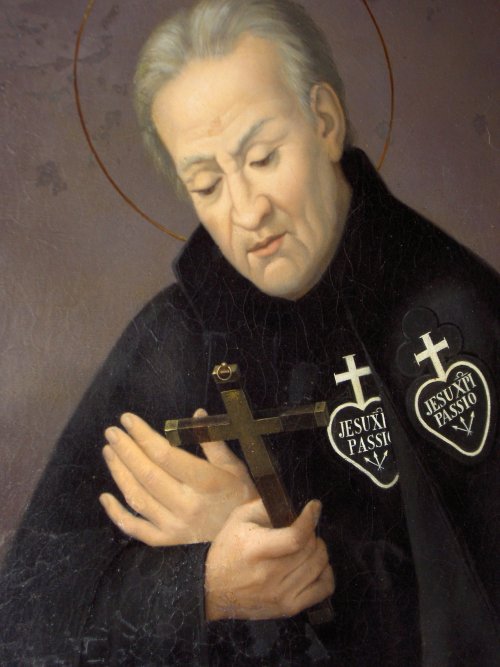
Paolo Francesco Danei was born to a small merchant-shopkeeper family in the small Ligurian Apennine town of Ovada. After a single-day attempt at the military service for the Republic of Venice (he left after a personal vision in church) and a near-marriage to a young woman of his town, he received in late 1720 a series of mystical experiences he interpreted as a call to found a new religious congregation dedicated specifically to keeping the memory of the Passion of Christ alive in the Church. The bishop of Alessandria received his vows in November 1720 and clothed him in the black tunic with the white heart-shaped insignia bearing the words Iesu XPI Passio — the original Passionist habit.
He spent the next forty years (1720–60) founding the Congregation of the Passion (the Passionists). The order was confirmed by Benedict XIV in 1741 with severe restrictions and only definitively approved by Clement XIV in 1769. Throughout the long process Paul preached an estimated three hundred and twenty parish missions across Italy, centered always on extended meditative reflection on the Passion of Christ, accompanied by extraordinary mystical phenomena — repeated bilocations, levitations during preaching attested by independent witnesses, and the bodily marks of the Passion that appeared periodically on his side and feet.
He died at the Roman Passionist house of Santi Giovanni e Paolo on the Caelian Hill on October 18, 1775. Canonized 1867.