
MIRACULOUS MIRACLES™

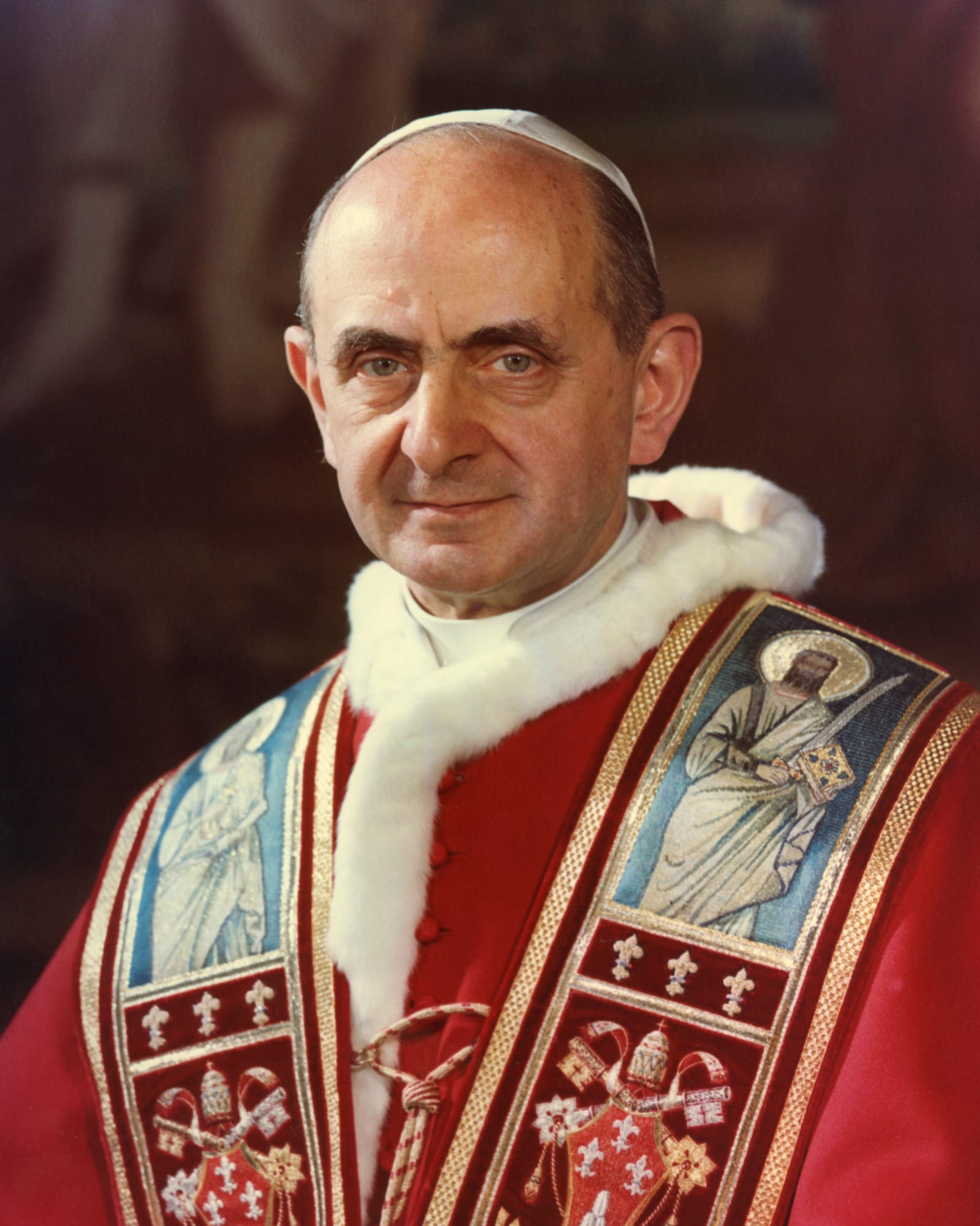
Saint — Paul VI

St. Paul VI
September 26, 1897, Concesio, near Brescia — August 6, 1978, Castel Gandolfo
Pope of Humanae Vitae and the completion of Vatican II
St. Peter's Basilica, Vatican, Vatican City
♕ The 262nd Bishop of RomeReign: June 21, 1963 — August 6, 1978
Feast
May 29
Canonized
October 14, 2018 (by Francis)
Beatified
October 19, 2014 (by Francis)
Life

Giovanni Battista Montini was born in Concesio, near Brescia, to a Catholic newspaper editor and a noblewoman of strong piety. His health was fragile from boyhood. Ordained in 1920, he spent thirty years in the Vatican Secretariat of State (under Pius XI and Pius XII), helping shape Catholic Action and the wartime humanitarian effort. Made Archbishop of Milan in 1954, he became a 'workers' archbishop' in the heart of postwar industrial Italy.

Elected pope in June 1963 after the death of John XXIII, he immediately committed himself to continuing the Council. He presided over its three remaining sessions, promulgated all sixteen of its documents, and undertook the herculean task of implementing its reforms — a liturgical reform (the new Missal of 1969), a curial reform, an ecumenical opening (the meetings with the Ecumenical Patriarch Athenagoras in Jerusalem, 1964, ending the mutual excommunications of 1054), and a dialogue with the modern world.

In 1968 he issued Humanae Vitae, the encyclical reaffirming the Church's traditional rejection of artificial contraception. The reception was bitter: many of his closest collaborators dissented publicly; episcopal conferences hedged; Paul never wrote another encyclical for the remaining decade of his life. His final years were marked by deepening sorrow — the kidnapping and murder of his close personal friend, the former prime minister Aldo Moro, in 1978 led to one of the most anguished public letters of any modern pope. He died at Castel Gandolfo on the feast of the Transfiguration, August 6, 1978.

Canonised by Francis on October 14, 2018, jointly with St. Óscar Romero of El Salvador. With this canonisation, the three popes who guided the Catholic Church through the Second Vatican Council — John XXIII, Paul VI, and John Paul II — are all saints.

Miracles & Phenomena
  • Promulgation of Vatican II

    Sixteen Council documents — Lumen Gentium on the Church, Dei Verbum on Revelation, Sacrosanctum Concilium on the Liturgy, Gaudium et Spes on the Church in the modern world, Nostra Aetate on non-Christian religions, and the rest — were promulgated under his signature. He gave the Council its reception even when its reception nearly broke him.

  • Embrace with Patriarch Athenagoras (Jerusalem, 1964)

    January 5–6, 1964; declaration December 7, 1965

    On January 5–6, 1964, in Jerusalem, Paul VI and the Ecumenical Patriarch Athenagoras I met face-to-face — the first such meeting since 1438. They jointly lifted the mutual excommunications of 1054 in a 'Joint Declaration' read simultaneously in Rome and Constantinople on December 7, 1965. The act remains the most significant ecumenical gesture of the 20th century.

  • Cure of an unborn baby (beatification miracle)

    An unborn baby in California (Vanna Pironato's son) was healed of a severe condition in 2001 after the mother prayed at Paul VI's tomb. Accepted as the miracle for his 2014 beatification.

  • Cure of an unborn baby (canonisation miracle)

    An Italian unborn child diagnosed with anencephaly and ruptured membranes was cured in utero in 2014 after the mother prayed for Paul VI's intercession at Brescia. Accepted as the miracle for his 2018 canonisation.

Relics
  • Body
    Tomb of St. Paul VI
    Vatican Grottoes, St. Peter's Basilica, Vatican

    At his own request, his tomb is a simple slab of bare earth and stone in the grottoes beneath St. Peter's, without ornament. The bareness is itself iconographic.

  • Vestment
    Bloodstained undershirt of Paul VI
    Diocesan archive, Brescia

    The undershirt he wore on November 27, 1970, when he survived an assassination attempt by a knife-wielding attacker in Manila, is preserved as a first-class relic.

Iconography
  • Paul VI at the Council

    Often depicted seated at the high desk of St. Peter's during the great Council sessions, signing or promulgating documents. The 1965 photograph of his closing of the Council, with the Mass of Closing facing the people, is itself an iconic image.

  • The Embrace with Athenagoras

    The January 1964 image of the two patriarchs embracing in Jerusalem became one of the great religious photographs of the 20th century. It has been reproduced in mosaic in the Patriarchal Cathedral of St. George in Istanbul and at the Vatican.

Patronages
World Meeting of FamiliesConcesioBrescia
Sources & Further Reading