
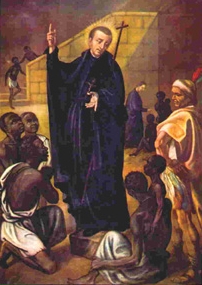
Peter (Spanish Pedro) Claver was born on June 26, 1580 at Verdú in Catalonia to a noble Catalan Claver family. In 1602 (at 22), Peter entered the Society of Jesus at Tarragona.
In 1605, Peter undertook the Jesuit formation at the Jesuit College of Montesión at Palma de Mallorca — where he received the personal spiritual direction of the Jesuit lay-brother porter St. Alphonsus Rodriguez SJ (see his entry). Alphonsus Rodriguez personally identified Peter's vocation to the Colombian slaves' apostolate.
In 1610, Peter sailed for the Spanish colonial port of Cartagena in New Granada (modern Colombia) — the principal Spanish American slave-trading port of the 17th century (receiving tens of thousands of African slaves annually from the Portuguese slave-trading network).
Ordained priest at Cartagena in 1616, Peter undertook the vocation of ministering to the African slaves arriving at Cartagena. Peter signed his solemn Jesuit vows with the formula: 'Petrus Claver, aethiopum semper servus' ('Peter Claver, slave of the slaves forever').
For the 40 years (1615–1654), Peter undertook the systematic ministry to the African slaves at Cartagena. His pattern: waiting at the Cartagena docks for the arrival of the slave ships; boarding the slave ships before the disembarkation to minister to the slaves in the holds; leading the disembarking slaves to the Jesuit hospital where he personally washed them, fed them, and treated their wounds; beginning the systematic catechesis through interpreters (producing teams of multi-lingual African converts to serve as interpreters).
Peter personally baptized documented over 300,000 African slaves during his 40-year Cartagena ministry — the most extensively documented individual sacramental ministry in Catholic missionary history.
Peter undertook the anti-slavery advocacy — denouncing the Spanish colonial slave-trade system, defending the human dignity of the African slaves against the Spanish colonial slaveholders, and establishing the theological principle that the African slaves were 'baptized rational beings' deserving pastoral care.
In 1650, Peter contracted a chronic illness that left him partially paralyzed. Peter spent the final four years of his life (1650–1654) in hidden humility — cared for by the former African slave he had baptized and freed.
He died at Cartagena on September 8, 1654 at the age of 74.
Canonized on January 15, 1888 by Pope Leo XIII simultaneously with St. Alphonsus Rodriguez SJ, his personal spiritual director — the double-canonization recognized the Alphonsus-Claver Jesuit spiritual-friendship tradition.
In 1896 Pope Leo XIII declared Peter Claver the patron of Catholic missions to African peoples worldwide.